
Microphones are part of the essential tools in the studio — and of course in home studios. Indeed, for quality sound recording, choosing a good studio microphone is crucial.
However, if you are new to recording or simply looking for a new microphone, you may feel a bit lost or overwhelmed by the amount of information to consider.
There are indeed all sorts of brands, models, types, and criteria to take into account – not to mention significant price variations from one model to another.
I regularly receive emails or comments asking me: What is the best microphone for singing? For guitar? Should I choose a condenser or dynamic mic? I want to record rap, what should I choose? What do you think of the MXL 4000 condenser microphone? How do I choose my first microphone?
To guide you in your research, I have taken the time to write this detailed guide that will provide you with all the necessary information to choose a professional studio microphone that matches the intended use.
Here are the topics covered in this article:
- The characteristics of microphones
- The types of studio microphones
- The best studio microphones by use
- Microphone accessories
The characteristics of microphones
Whether dedicated to studio/home studio use or not, microphones share a set of characteristics that allow, among other things, to compare them when purchasing or selecting for a recording.
Directivity

Directivity is one of the most important parameters to consider when choosing a microphone. Indeed, it refers to the microphone’s sensitivity to sounds based on the direction they come from.
Thus, some microphones (called cardioid) will only be sensitive to sounds coming from the front, while others (called omnidirectional) will equally capture sounds coming from the front, sides, or back.
Finally, there are also microphones with a directivity known as figure 8, which are sensitive to sounds coming from the front and back but not to sound sources located on the sides.
For beginners, it is often recommended to initially opt for cardioid microphones (with hyper- and supercardioid variations) which will be a bit easier to position.
It is worth noting that some microphones are multidirectional, meaning they can be adjusted for different directivities — which can also be useful in a home studio if you appreciate having access to a maximum of sound options.
More details on this topic are available in my article on the different directivities of microphones.
Frequency Response
On average, the human ear can hear sounds between 20 and 20000 Hz.
Due to their construction, microphones are often sensitive to sounds corresponding to a slightly narrower frequency range, for example from 50 Hz to 15000 Hz. This is one of the parameters communicated by the manufacturer, usually under the term “Frequency Response” (Réponse en Fréquence in French).
When purchasing a studio mic, as well as when selecting it to record a specific instrument, it is important to take this parameter into account. For example, if a microphone tends to lose sensitivity below 100 Hz, it will likely not be suitable for recording bass or kick drum.
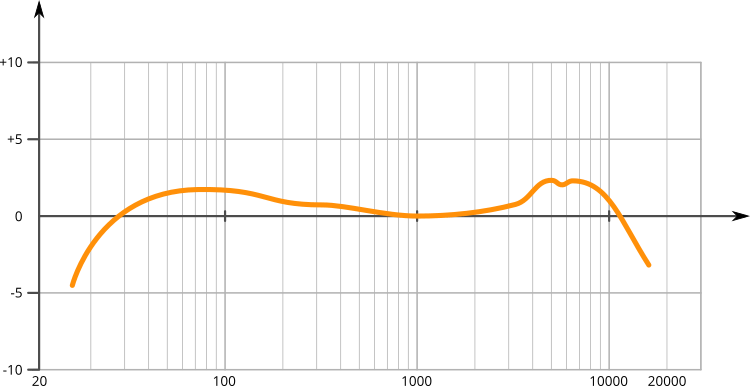
For more precision, it is particularly useful to take a look at what is called the “Response Chart” (Response Chart or Response Curve), which is a graph representing the sensitivity of the microphone as a function of frequency. Indeed, the sensitivity of a microphone is never completely identical for all frequencies: sometimes, the recorded signal will be stronger in the lows, or in the highs, more or less balanced… all configurations are possible!
A response curve will typically look like this:
Off-axis coloration
The frequency response curve generally concerns recordings made exactly on-axis of the microphone.
Most of the time, however, a microphone will not have the same response or saturation characteristics depending on the direction from which the sound comes.
This is referred to as off-axis coloration.

Depending on the manufacturers, this type of information is sometimes available in the form of additional response graphs or polar diagrams.
If you want to record a non-directional sound source, such as an orchestra, a piano, or drum overheads, it will likely be useful to look at this type of information to ensure it matches what you are looking for.
On the other hand, if you are only recording solo singers, it will be a bit less important.
The diaphragm size

The diaphragm size is part of the characteristics generally communicated by studio microphone brands, especially regarding condenser microphones.
The difference between a “small diaphragm” and a “large diaphragm” is sometimes a bit arbitrary, but it often shows in the shape of the microphone:
- small diaphragm microphones will have an elongated shape, like a pencil, and the capsule will be located at the end of the body;
- large diaphragm microphones will be bulky and the capsule will be oriented to the side.
In terms of sound, it can generally be observed that small diaphragm microphones are more natural and respond better to transients. Their directivity is also more stable across all frequencies.
Large diaphragm microphones, on the other hand, often have a more colored, flattering sound and tend to generate lower background noise.
Maximum Sound Pressure Level (SPL Maximum)
The maximum SPL is simply the sound level in decibels at which the signal recorded by the microphone begins to audibly distort. If this level is reached too frequently, it is even possible that it could damage the capsule/membrane.
In a studio or home studio, this parameter will be especially important if you want to record a drum kit or a guitar amp at high volume. Conversely, if your recordings mainly involve voices or acoustic instruments, the maximum SPL should not be an issue.
Power Supply
Dynamic microphones generally do not require power.
On the other hand, all static microphones as well as some ribbon microphones require what is called phantom power, a term coined in the 1960s by the famous German manufacturer Neumann. Simply put, it is a technology that allows the microphone to be powered with electrical current via the XLR cable through which the recorded signal also passes.
Today, most audio interfaces natively integrate phantom power set to provide a standard voltage of +48 volts.
However, some microphones come with a specific external power supply: this is often the case with tube static microphones that require a particular power supply.
Price
Yes, the price is also one of the criteria to consider when choosing a new mic.
If this seems obvious and is mostly dependent on the size of your wallet, I have deliberately mentioned it here to highlight two or three particular points often poorly understood by home studio users.
First of all, it is important to realize that price is not always a factor of quality: a €100 microphone can very well be better than a €2000 microphone for certain applications. I am particularly thinking of the Shure SM57, which is a true reference for recording guitar amps.
Moreover, if for example your studio or home studio has not received good acoustic treatment or if your preamps are of average quality, it is likely that you will not really hear the difference between a great microphone and an entry-level or mid-range mic. So, there is no need to spend €3000 if the acoustics of your studio are not under control…
Finally, it is also important to keep in mind that regarding studio microphones, a price difference of €50 or €100 between two models is rarely significant: a financial addition of this magnitude will not necessarily bring better sound quality.
Types of Studio Microphones
Studio microphones are divided into various more or less precise categories: there are dynamic microphones, static microphones, and ribbon microphones.
Ideally, whether in a professional studio or a small home studio, it is always advisable to have several types of microphones available. Indeed, depending on the recorded instrument, some models will sound better than others. Having access to different models and thus different sound textures is therefore a real asset.
So don’t look for “THE best studio microphone”, unfortunately, it does not exist… 😉
1. Dynamic Studio Microphones

Dynamic microphones are absolutely essential in the studio.
Although they are sometimes a bit neglected in favor of static microphones that we will discuss shortly, because their sound is a bit less detailed, they are still absolutely excellent tools, especially for recording drums or guitar amps.
Inexpensive and generally very sturdy, they also stand out for a lower sensitivity to the acoustics of the room in which they are. In other words, if you are just starting out and the place where you are recording does not have good acoustics, I strongly recommend that you lean towards this type of microphone.
If I had to recommend only one model, it would undoubtedly be the very well-known Shure SM7B, used by Michael Jackson on the album Thriller and shown in the photo alongside.
Compare the price of the SM7B at: Thomann – Woodbrass – Amazon
► For more info, check out my list of the best dynamic microphones.
2. Studio Condenser Microphones
Condenser microphones, also known as “capacitor” microphones, are mainly divided between large diaphragm and small diaphragm types.
However, I have isolated a third category for tube microphones, generally with large diaphragms, which remain quite specific.

Large Diaphragm Microphones
These are the quintessential studio microphones.
Typically having a detailed and very pleasant sound, large diaphragm microphones adapt well to many types of sound capture but are primarily excellent choices for vocals and acoustic instruments.
Generally powered electrically via phantom power, these are probably the ones I recommend you turn to if you are looking for your first microphone to start your home studio.
There are a huge variety of different models, with prices ranging from €50 for entry-level to €10,000 for high-end vintage. Fortunately, many affordable and excellent quality models have emerged in recent years.
If I had to recommend just one, it would undoubtedly be the Origin from the English brand Aston Microphones, which has an impressive quality/price ratio.
Compare the price of the Origin at: Thomann – Woodbrass – Amazon
► To go further, check out my recommendations for the best large diaphragm condenser microphones.
Small Diaphragm Microphones
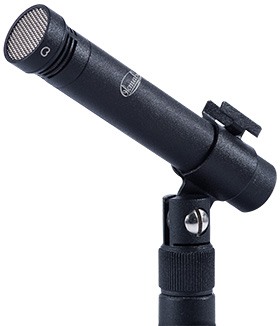
Small diaphragm condenser microphones are a very good choice if you are looking for a neutral, transparent, and very detailed sound capture. Their small size allows them to faithfully reproduce very high frequencies and simplifies their positioning.
Moreover, they handle sounds with a sharp and fast attack (transient) very well, such as percussion and cymbals.
Like all condenser microphones, you will need phantom power to operate them.
► To go further, check out my recommendations for the best small diaphragm condenser microphones.

Tube Microphones
Among condenser/static microphones, there exists a somewhat specific category: tube microphones.
These are characterized by the addition of a vacuum tube (also called a lamp) in the integrated circuit of the microphone, which gives certain interesting characteristics to the sound. Notably, it is often warmer, has more harmonics, and sometimes resembles what one would expect from a “vintage” sound.
It should be noted that these tube microphones require a dedicated power supply in the form of an external box, which undoubtedly contributes to their generally high price.
A model that I recommend in this category: the WA47 from Warm Audio.
Compare the price of the WA47 on Thomann Woodbrass Amazon
3. Ribbon studio microphones

A little-known fact, ribbon microphones are actually dynamic microphones. However, their very specific construction and the particular sound that results justify their being set apart.
Indeed, these mics capture sound using a very thin aluminum ribbon (less than 4 microns!) located between two magnets. The vibrations of the ribbon alter the existing magnetic field, generating an electrical signal.
In terms of sound, ribbon microphones generally provide a silky texture while naturally reproducing the dynamic and harmonic variations of instruments. They also tend to have a somewhat vintage sound, as they poorly reproduce the highest frequencies.
Be careful though: they are generally quite fragile!
► If this type of mic interests you, check out my selection of the best ribbon microphones which should guide you in the right direction.
4. Surface / Pressure zone microphones

Pressure zone microphones (PZM) are hardly ever used in home studios, but some professional studios employ them in various situations.
For example, they can be quite interesting when placed against a wall or on the floor as “room mics” for ambient sound capture. Often, they can also be inserted into a kick drum to capture low frequencies.
If you want to try something a little different from more traditional microphones, feel free to check out the Beta 91a from Shure.
Compare the price of the Beta 91a on Thomann Woodbrass Amazon
5. USB microphones

To be honest, I hesitated a bit to mention USB microphones in this article.
It’s difficult to talk about “USB studio microphones” since they contain a dedicated sound card that generally does not allow the use of other microphones or preamps.
That said, in some cases, a USB microphone can be useful in a home studio.
For example, if you simply want to record a few quick ideas on guitar without necessarily producing an album afterward. Or, if you also want to use it for your Skype conversations…
By default, a viable option is to consider the Blue Yeti in the photo next to it, which may suit you.
In this regard, you can read my review of the Blue Yeti or directly compare its price on Thomann Woodbrass Amazon
The best studio microphones by use
Depending on how you want to use your microphones, certain models and types may be more suitable than others. There are no absolute rules, and I strongly encourage you to experiment with various setups, but on the other hand, you probably won’t use the same microphone for singing, drums, or acoustic guitar.
Here are a few recommendations based on the intended use… 🙂
1. For singing / voice
For anything vocal, except perhaps choirs, we often turn to large diaphragm condenser microphones. These are typically the ones you see in photos of artists in the studio, and rightly so: their high sensitivity is ideal for best reproducing the voice.
However, there are a number of interesting alternatives, particularly among dynamic microphones, which are sometimes wrongly overlooked by home studios.
For beginners, the RØDE NT1-A will be a good first microphone for singing, both reliable and accessible: compare the price on Thomann – Woodbrass – Amazon
► For more information, check out my list of best microphones for recording singing and voice.
► If you are specifically looking for a microphone for rap, this selection will also help you.

2. For Voice Overs
If your budget is tight and you want to record voice overs for a film, documentary, or advertisement, then I recommend first looking at my article on singing microphones mentioned above.
However, there are reference microphones for anything related to spoken voice and voice overs, such as the Sennheiser MKH 416 or the Neumann U87.
► If this area interests you, check out my list of microphones for recording voice overs. 🙂
3. For podcasting, broadcasting, radio
In the world of spoken voice for podcasts or radio, it is also important to choose the right microphone.
We often prefer dynamic microphones like this one since they are less sensitive to the acoustic flaws of the room — and thus will provide better quality recordings in untreated rooms.
► For more info, check out my selection of the best microphones for podcasts / radio
4. For guitar amplifiers
Recording a guitar amp is quite specific, as sound levels are generally high and the choice of microphone greatly influences the final sound.
This time, condenser microphones are not necessarily the most recommended: generally, it makes more sense to opt for dynamic microphones placed close to the speaker grille or ribbon mics (like those from Royer Labs) positioned further away for a less concentrated sound.
The reference?
Simply the famous SM57 from Shure (yes, it’s him again!): compare the price on Thomann – Woodbrass – Amazon
► To go further, feel free to check out this article: The Best Microphones for Recording Electric Guitar.

5. For Acoustic Guitar
The acoustic guitar is, much like the voice, a rather delicate instrument whose recording can prove to be more complicated than one might think.
Indeed, depending on the chosen microphone and its position, the plucking of the strings and the resonance of the body will be more or less present.
With the choice of an appropriate microphone, you will have a much better chance of obtaining a recording that accurately reflects the natural character and articulation of the notes, whereas with an unsuitable mic, the sound will quickly be perceived as imperfect.
One of my favorite microphones for this use is the Origin, which I mentioned a little earlier: see the price on Thomann – Woodbrass – Amazon
► As usual, there are many options, but feel free to take a look at my selection of the best microphones for acoustic guitar.
6. For Drums

The drum set is a bit special — as it is actually composed of several different instruments: bass drum, snare drum, hi-hat…
So, a series of microphones is generally used rather than just one to capture this instrument. Therefore, there isn’t just one choice to make, but several! Just to make things a bit more complex! 😉
► But fortunately, to help you on this topic, here is my guide to microphones for recording drums.
7. For Piano

The piano, on the other hand, is a delicate instrument that can be complicated to capture well.
While it is possible to get a decent sound with most static microphones, it is still necessary to place them correctly.
► Check out my guide on microphones for piano
8. For Brass
For trumpets, saxophones, or horns, I would tend to recommend a dynamic microphone (for close miking) or a ribbon microphone (for slightly more distant miking).
For example, try a Shure SM57, which is often well-suited for this type of recording.
Microphone Accessories
A studio microphone is never used alone: you will need a number of accessories.
Here are some tips on the most common ones. 🙂
1. The Pop Filter

If you are recording singing or voices, a pop filter is an absolutely essential accessory.
It is simply a mesh screen made of fabric or metal placed in front of the microphone. It helps to eliminate or at least reduce the pop sounds produced by letters like « p » and « b » (known as plosives) when pronounced.
If you want a professional sound, having such a filter is more than recommended.
It is generally not necessary to spend a fortune on this tool, but you should still get something decent — if only to have something easy to position that won’t fall over all the time.
► To buy a good filter, check out my selection of pop filters for the studio
2. The Shock Mount

In the studio, it’s not like at a concert: the attachment of the microphone to the stand is much more important than it seems.
If your microphone comes without anything or just with a clip, I can only recommend getting an elastic suspension (or something similar).
The advantage is that this mounting system isolates the microphone from the stand as much as possible, which maximizes the quality of the recordings. Indeed, with a suspension, the vibrations produced by the singer’s foot tapping or by the truck passing on the nearby street will be significantly reduced.
Generally, each brand has its own shock mounts. However, they can sometimes be quite expensive — so I recommend opting for a standard model like the USM (Universal Studio Mount) produced by Rycote, shown in the picture next to it (compare the price on Thomann – Amazon).
3. The Microphone Stand

While dynamic microphones can theoretically be held by hand while producing minimal handling noise, condenser microphones should not be held during recording.
A studio microphone should always be placed on a stand.
Especially, avoid the cheapest stands with heavier microphones (especially condenser microphones which are also more fragile), as the tightening screws are often a bit limited and rarely sufficient to hold your microphone. It’s better to invest right away in something solid! 🙂
Those from the German brand K&M are generally referenced. For example, take a look at the model 210/9: Woodbrass Thomann Amazon
4. The XLR Cable

To connect your microphone to your preamplifier, you obviously need an XLR cable.
First of all, avoid getting a cable that is too long. There’s no need for 10 meters if your audio interface or preamp is 2 meters away. The longer the cable, the more likely it is to pick up interference that could degrade the sound.
Additionally, investing in a good quality cable is generally a good idea: sure, there are XLR cables for two euros — but they won’t last long and will be more susceptible to electromagnetic interference.
► My guide to the best XLR cables contains all my purchasing advice on this topic
5. The Acoustic Screen

Finally, to maximize the quality of your recordings and especially for singing, an acoustic screen (or reflection filter) is often a good idea — especially in a home studio.
Simply put, it is a structure that is positioned around the microphone. Thanks to absorbent materials (like acoustic foams) placed inside, the acoustic screen limits reflections and allows for clearer recordings, less sensitive to the natural reverb of the room.
In this category, the model from Aston Microphones is clearly the best, although a bit pricey:
However, it’s important to remain aware that an acoustic screen is just an aid and it won’t mask all the acoustic problems of a studio. For that, it’s better to look towards standard acoustic treatment.
Conclusion
Whether you are recording in a professional studio or a home studio, having access to good microphones is an important first step for achieving quality recordings.
But choosing a first or new microphone involves knowing the different types and the situations in which they can be used. I hope this guide has provided you with a wealth of information on this topic.
If you still have questions, feel free to leave a comment below — I will respond 🙂
Good recordings!
Continue reading: The best audio interfaces (USB, Thunderbolt…)