
Are you looking for a microphone preamp for your (home) studio?
Maybe to achieve warmer recordings? With more of an “analog” feel? Or to enhance your vocal recordings with a clearer, more detailed sound than that of your interface?
Then you’ve come to the right article! 🙂
Microphone preamps are part of the standard studio equipment, which should not be overlooked: having a (or several) quality preamp will help bring your recordings to life and can even simplify the mixing phase.
To guide you in your search, and especially to help you avoid buying a preamp that would only harm the quality of your recordings, I decided to write this article which I hope will be as comprehensive as possible.
That said, remember that every element in the signal chain is important, and a preamp alone cannot do everything. Make sure to pair your preamp with a good studio microphone.
Article content:
What is a microphone preamp for?
If you’re new to recording and (home) studios, you’ve probably heard that you need a preamp.
But perhaps the definition of what it is isn’t quite clear.
So, before going further, let’s take a few seconds to clarify this subject.

Studio microphones, in general, emit a very weak signal.
We talk about mic level or signal at microphone level.
However, most of the equipment around you, whether it’s compressors, equalizers, or AD/DA converters to transfer the signal to your home studio computer — all this equipment expects a signal at line level to function.
And the line level is much higher.
Not surprisingly, this is where the microphone preamp comes in: it will amplify the signal at microphone level to raise it to line level.
To give you an idea, you need between 30 and 70 dB of gain for normal use (this depends on the microphone, and of course, the volume of the recorded sound source).
Buying guide: the characteristics of microphone preamps
There are all sorts of microphone preamps, with all sorts of features — whether in terms of sound or connectivity.
To make your choice, you need to ask yourself the right questions.
Also, to help you, here’s a list of the main characteristics to consider when selecting a new preamp for your studio.
The number of channels
This is probably the most obvious selection criterion: you need to define how many inputs you need.
Of course, the more channels the preamp has, the higher the price will be.
In most cases, one or two inputs are sufficient.
Indeed, since instruments are generally recorded separately, it is rarely useful to have a preamp with more than two channels…
…unless you want to record a drum kit, for example. In that case, I can only recommend that you look for microphone preamps with 8 inputs, which will likely be the most practical to use for this application.
You will find recommendations for this type of model at the end of the article.

The gain
The amount of gain provided by the preamp is the second technical criterion to consider.
If you want to amplify dynamic microphones (SM57, SM7B…) or ribbon microphones, try to choose a mic preamp with at least 60 dB of gain, or even more.
Below that, you might have trouble getting a signal at a correct level from your microphone.
Or, you would be forced to turn the gain all the way up, which can sometimes generate additional background noise and/or distortion.
Note that condenser microphones, on the other hand, are generally not affected by this type of problem.
Instrument Input (DI)
Instruments such as electric guitars or basses have a different output level than the microphone level. This is referred to as instrument level.
To adjust this level and have the proper input impedance, some preamps include an instrument input (Hi-Z, high impedance…), which simply contains the equivalent of a DI box.
If the preamp you are interested in does not have this type of input, you will need to use a dedicated DI Box to provide the preamp with an adequate signal level.
The Color of Sound
Overall, there are two types of mic preamps:
- those with a transparent sound;
- and those with a colored sound.
The former will tend to reproduce sound neutrally, without adding coloration. They amplify the signal while minimizing the impact on frequencies and distortion.
The latter, on the other hand, will modify the sound by influencing the distribution of frequencies and generating additional harmonics. This can result in a warmer, brighter, denser sound, or with an increased sense of 3D dimension.
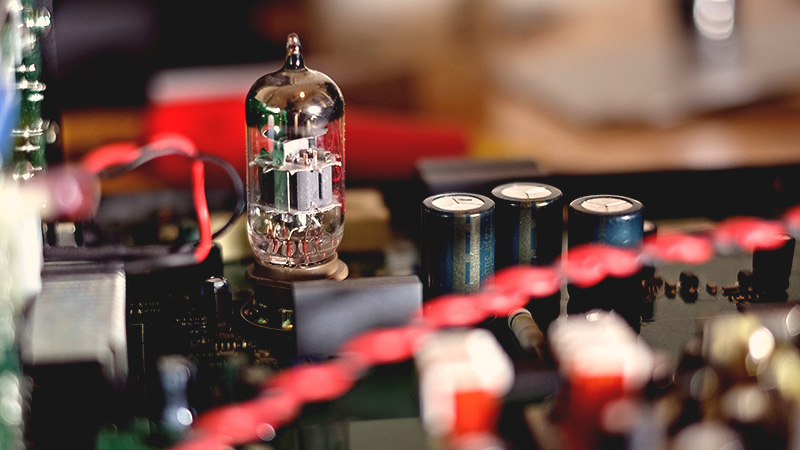
For your (home) studio, having several options would be ideal. But since this is often only possible in the long term, try to choose a preamp that differs from what you already have.
If, for example, you already have a transparent preamp, another preamp of the same type won’t bring you much: prefer a more colored model.
However, be careful: when we talk about warm sound or vintage sound, we often think of tube equipment.
However, tube mic preamps are not necessarily the most colored, and they are especially very expensive….
… and cheaper models are often very disappointing.
With the exception of those mentioned a little further down in the article, I would therefore advise you, if you are looking for a warm sound with character, to consider preamps like the Warm Audio TB12 or the Stam Audio 1073MPA.
Connection
99% of the time, your preamp will output a balanced audio signal, providing XLR and/or TRS connectors at the output.
Make sure, when you order it, to have the appropriate cables available (or to order them at the same time).
👉 If the concepts of TS/TRS jacks are not clear to you, feel free to check out my guide on audio cables.
Price
Finally, a microphone preamp can be quite expensive.
If you already own an audio interface, but you want to upgrade your preamps, I recommend aiming for a budget of at least €250-300 per channel.
Below that, you will generally only find low-end preamps that will not allow you to achieve better sound (with the exception of the first two models below, which are a bit specific).
Now that you have all the necessary information, here is my selection of the best studio mic preamps.
As usual in my articles, I have tried to offer you mostly preamps that are relatively accessible for a home studio budget. Because there are of course high-end preamps at €3000, but for most of us, they remain quite inaccessible. 😉
1. TritonAudio Fethead

Brand : TritonAudio
Inputs : 1
Gain : +27 dB
The Fethead from TritonAudio is a bit special because although it is a preamp, it alone is not sufficient to boost a signal.
But that is completely normal because it has a very specific role: to provide additional gain to dynamic or ribbon microphones before they enter, for example, the preamp of your audio interface.
In other words, the Fethead serves as an extremely transparent additional gain stage. It even tends to improve the sound, especially on transients, as it corrects the output impedance of the microphones to better match the subsequent preamps.
Finally, as it is powered via phantom power, it also helps protect your ribbon mics from it. No more risk of damaging them by sending 48 Volts!
An almost indispensable accessory, after all, for any home studio 🙂
► See the current price on : Thomann Amazon NoHype Audio
2. Cloud Microphones Cloudlifter

Brand : Cloud Microphones
Inputs : 1 or 2
Gain : +25 dB
Another option in the same style as the Fethead mentioned above: the Cloudlifter.
Made in the USA, it also provides extremely clean, very transparent gain, which allows for 25 decibels of additional gain thanks to JFET transistors.
Ideal, therefore, for using an SM57 or SM7B on a small interface like the Focusrite Scarlett, which otherwise would not have enough gain to amplify these microphones.
Note that there are several versions of the Cloudlifter, including a mono version and a stereo version.
► See the current price :
3. Golden Age Project Pre-73 Jr
Brand : Golden Age Project
Inputs : 1
Gain : +70 dB
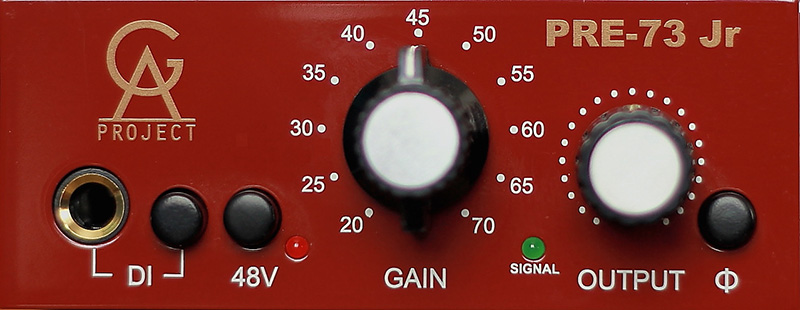
If you’re looking for a mic preamp with a colored sound but at an accessible price, I recommend taking a look at this smaller model of the Pre-73, inspired by the Neve 1073.
Delivering a gain ranging from 20 to 70 dB, the Pre-73 Jr features a discrete electrical circuit, meaning no integrated circuit, with signal balancing via transformers at both the input and output.
It also has a high-impedance instrument input, and its power supply located in an external housing undoubtedly helps to minimize interference on the audio signal passing through the preamp.
Interestingly, this Pre-73 Jr also includes an output gain adjustment, which can be reduced if needed to push the main gain stage and thus achieve a sound with more character.
► See the current price at: Thomann Amazon
4. Art Pro MPA II

Brand: Art Pro Audio
Inputs: 2
Gain: up to +70 dB
In the entry/mid-range, as I mentioned at the beginning of the article, there aren’t really any very good tube mic preamps.
Nevertheless, the Art Pro MPA II holds up quite well for its price — especially since it has two channels (each with a high-impedance instrument input on the front).
I would even say that in this price range, it’s the only one I would recommend.
Particularly because it can really add a certain color to the sound thanks to the various settings available, such as the ability to adjust the voltage of the tubes or the input impedance (very useful for getting better sound from ribbon microphones).
Equipped with nice VU meters that will undoubtedly look great in your studio, the Art Pro MPA II provides only 40 dB of native gain, with an additional +20 dB before the tube preamplification stage and +10 dB at the output. This brings it to a theoretical value of around 70 dB.
A little tip to improve the sound: don’t hesitate to replace the “made-in-China” tubes it comes with with better tubes.
► See the current price at: Thomann Woodbrass Amazon
Very focused on home studios and mobile studios, the ISA One also includes a good quality headphone amplifier. Optionally, you also have the possibility to add an AD/DA conversion card (AES/EBU, S/PDIF, and optical outputs).
► See the current price at: Thomann Woodbrass Amazon
6. FMR RNP 8380

Brand: FMR Audio
Inputs: 2
Gain: +66 dB
If you are looking for a very good quality transparent preamp at a relatively reasonable price, I particularly recommend turning to the “Really Nice Preamp” (RNP) from FMR.
Sure, the design may not please everyone, but that’s because the brand (American) is much more focused on sound quality than on marketing.
The FMR RNP preamp includes two channels, each with a Hi-Z (high impedance) input and a dedicated phantom power supply.
The whole setup is excellent in a home studio, as the sound is both very neutral and very clear, with a lot of headroom available at the preamps. Indeed, if the background noise is slightly higher than on other models, it is probably because sound clarity was the priority.
Note: for each channel, an insert allows you to easily couple the preamp to compressors, such as the RNC 1773 from the same brand.
► See the current price at: Thomann
8. Heritage Audio HA73 Elite (and others)

Brand: Heritage Audio
Inputs: 1
Gain: +80 dB
The equipment from Heritage Audio is a big favorite of mine in general: the quality is there, and the price remains quite reasonable.
With the HA73 Elite, you get another preamp inspired by the Neve 1073 and equipped with all the options expected from this kind of gear: high input gain (80 dB), output gain to better saturate the built-in Carnhill transformers, DI input, high-pass filter, impedance control, and phase inversion switch.
After the TB12 mentioned earlier, this is probably my second recommendation if you are looking for a first microphone preamp for your home studio.
Note that there are several versions available: one or two channels, with or without equalizer.
► See the current price:
- Version without EQ (HA73 Elite): Thomann Woodbrass
- Version with EQ (HA73 EQ Elite): Thomann Woodbrass
9. Universal Audio Solo 610
Brand: Universal Audio
Inputs: 1
Gain: +61 dB
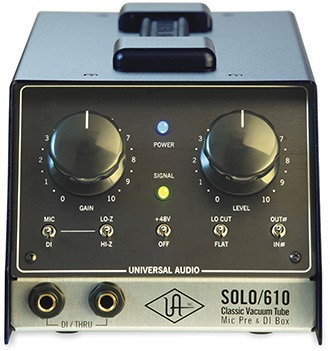
The Solo 610 from Universal Audio is said to be inspired by Bill Putnam’s 610 tube console.
In fact, it is a very good tube preamp, featuring a characteristic sound: details and analog warmth are present, along with an appreciable vintage feel.
As often, the input impedance is adjustable for increased flexibility.
The presence of an output gain control will allow you to drive the tubes harder without getting too strong a signal out. However, be careful to pair this preamp with the right microphones, as it is probably the least versatile on this list.
For fans of characterful tube sound!
► See the current price on: Thomann Woodbrass Amazon
10. Focusrite Scarlett OctoPre

Brand: Focusrite
Inputs: 8
Gain: +50 dB
If you need a lot of preamplified inputs, for example to record a drum kit, this is one of the two models I recommend.
The Focusrite OctoPre is positioned as an entry-level option, but that doesn’t prevent it from being of good quality.
Preamps are good with a slightly light gain, especially for dynamic/ribbon microphones. Overall, they are actually identical to those found on audio interfaces like the 2i2, 2i4, etc.: the sound is quite transparent and clear, sufficient for simple use.
The OctoPre includes two DI inputs, which will undoubtedly be very useful, and allows for digital output via ADAT connectivity.
Very good for small budgets.
► See the current price at: Thomann Woodbrass
11. Audient ASP800

Brand: Audient
Inputs: 8
Gain: +70 dB
Indeed, the Audient ASP800 looks a bit like the OctoPre mentioned just before, but we are here in the good mid-range. So, more expensive, but still providing a better sound.
First of all, there are two DI inputs based on a circuit using JFET transistors, offering a very detailed sound. In fact, similar to what you find on audio interfaces in the range such as the Audient iD22.
Moreover, on the first two channels, the ASP800 offers you saturation effects (which can be disabled) that may prove useful in some cases, based on MosFET transistors and transformers.
In total, you have access to 8 solid mic preamps, as well as very high-quality Burr Brown converters (dynamic range of 116 dB) accessible via the ADAT OUT.
A must if you need a lot of inputs…
► See the current price at: Thomann Woodbrass Amazon
In conclusion
Having one or more good mic preamps is important in a studio or home studio.
While the preamps integrated into standard interfaces are undoubtedly sufficient to get started, there inevitably comes a time when you will seek other sounds, other colors.
And with the models presented on this list, all of which are reliable choices, I am sure you will find what you are looking for in your next equipment upgrade! 🙂