
You may have been told that you need a direct box. But do you know why? Do you know what it’s for?
They are everywhere. In all studios, but also in concert halls, you will find direct boxes. They are also called DI boxes, or “DI Box” in English.
In a home studio, they are essential in many situations. They are often recommended for recording basses and guitars — and especially for reamping amps. However, it can sometimes be difficult to understand why they are necessary and which model you need.
Should you buy a passive or active DI?
Or, quite simply: how does it work?
You will find answers to all these questions in this article.
What is a DI Box?
DI boxes are devices that allow you to convert a high-impedance unbalanced audio signal into a low-impedance balanced signal.
I know, said like that, it’s not very understandable 🙂
But don’t worry, I will explain everything.
Unbalanced → Balanced Conversion
The input signal that you will send to your direct box is unbalanced. It’s simply the sound of your guitar, bass, keyboard, etc., transmitted via a standard jack cable.
Problem: unbalanced cables are much more sensitive to electromagnetic interference. These can be caused by many factors, such as poor quality cables or a cable passing through a magnetic field. The longer the cable, the worse the signal will be.
Balanced cables do not have this problem (XLR cables or TRS Jack cables). Hence the interest in using a DI, which will allow you to use long cables without hearing electrical buzz.
However, be careful: the cable you plug in at the input being unbalanced, make sure it is as short as possible.
The Ground Loop Problem
One of the recurring problems in home studios is that of ground loops (ground loops in English). Ground loops occur when electricity has multiple paths to ground. For example, if you connect two devices that are themselves grounded, you have a ground loop.
If (like me) you are not an electricity pro, a diagram will help you understand better:
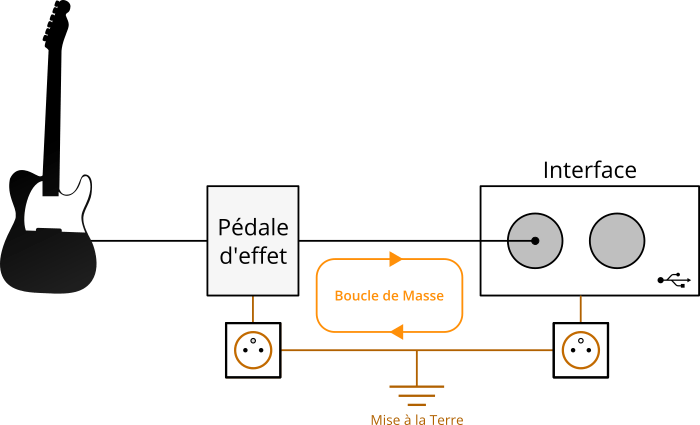
The consequence of this kind of configuration is a hum at 50 or 60 Hz (and its respective harmonics) that you will hear in your headphones or notice in your recordings.
Once again, DI boxes provide a solution: they will “cut” the ground loops. So, no humming.
Connectors and Impedances
DI boxes all have at least one input and two outputs.
The input, as you understood, is where you plug in your instrument. The input is then “at instrument level” (high impedance).
For the outputs, the signal is split into two: THRU and OUTPUT.
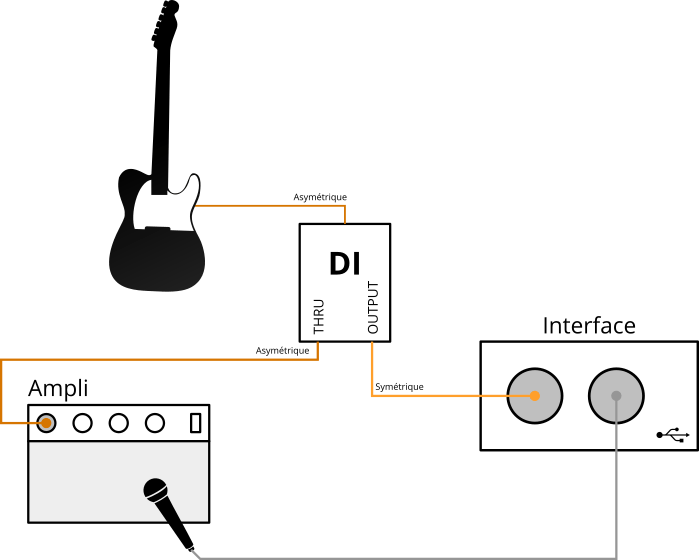
- The THRU output passes the signal without modifying it. You can connect it, for example, to an amplifier.
- The OUTPUT gives you a signal at “microphone level” (low impedance). This is the one you will connect to your mixing console or interface.
You can therefore record both the raw signal from your instrument (OUTPUT output) and your amp via a microphone if you wish (THRU output).
To make it clearer, here is an example of a classic setup in a home studio.
In Summary…
DI boxes will therefore allow you to:
- Transform your unbalanced signal into a balanced signal that is much less sensitive to electromagnetic interference, allowing you to use longer cables
- “Cut” ground loops and thus eliminate hum
- Convert your signal from “instrument” level to “microphone” level via an impedance change
- Record both the raw signal from your instrument and the output from an amplifier
Practical, right?
And once you have recorded your audio signal, you can even send it back to an amplifier using the reamping technique.
What is a passive DI box?
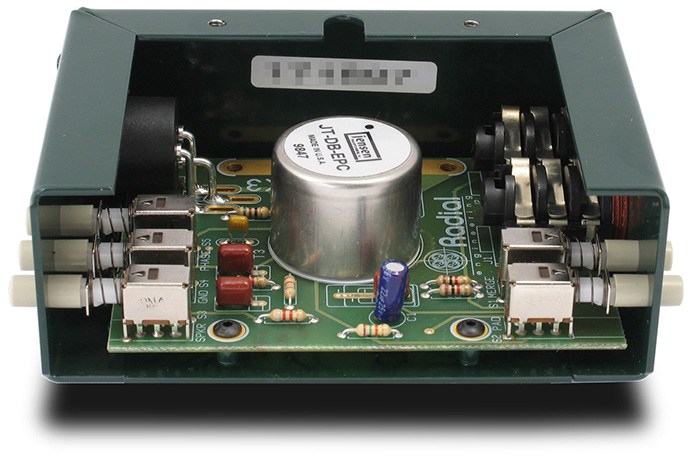
Passive direct boxes are simply devices built around an electrical component called a transformer.
In the image below, it is the circular aluminum-colored element.
How does it work?
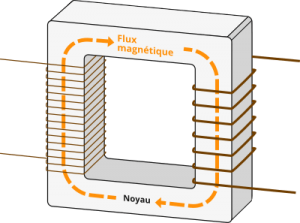
As you can see in the diagram on the right, a transformer consists of two windings. When current (= audio signal) reaches the first winding, it generates a magnetic field. This is then captured by the second winding, which converts it back into electrical current. In fact, this device acts as a kind of magnetic bridge for the audio signal.
The two windings are not in electrical contact. This is how electrical hum related to ground loops is eliminated, as the input signal and output signal are electrically isolated from each other.
Well – enough electronics for now! Let’s say a word about sound.
Transformers have the advantage of saturating smoothly and progressively. This means that with passive DIs, your signal is unlikely to suffer distortion if the input signal is a bit too strong, but will instead saturate in a more pleasant way.
Hence the importance of choosing a box with a quality transformer inside, to ensure the best possible sound reproduction.
Finally, one last important point: passive DI boxes are dedicated to active instruments, such as keyboards/synthesizers, guitars with active pickups, or electronic drums. If you connect a passive instrument (without an integrated amplification circuit) to a passive DI, you risk having a sound lacking clarity.
What is an active DI box?
Even though they have almost the same name as their passive counterparts, active DIs operate very differently.
Indeed, they contain a preamplifier that will boost the signal to change its impedance (from instrument level to microphone level). This is powered by a battery, or more commonly by phantom power, for example from your interface.
That’s why active DI boxes are reserved for passive instruments, such as a number of guitars and basses equipped with passive pickups.
Note also that unlike passive DIs that saturate gradually, active DIs go from 0 to 100% distortion as soon as the signal is too high. So be careful with your levels! 🙂
Which passive DI to choose?
It may seem quite difficult to choose a DI: there are all kinds of prices and colors!
However, among all the brands of direct boxes, there is one that really stands out: it is Radial Engineering.
Let’s be clear: as you connect your instrument to the DI, it will have an impact on your sound. So, set aside the “cheap” €30 boxes that will often harm the clarity of your audio signal. Especially if you are recording in a home studio context.
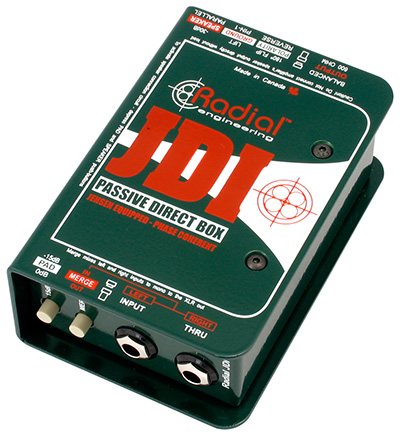
The passive model I recommend is the Radial JDI.
It is a very sturdy DI, suitable for both stage and studio use.
It is equipped with Jensen transformers made in the USA, which are perfect for audio processing. They handle very high-level signals very well and soften the transients (transients). As a result, you can use this direct box without any issues for instruments with very high output levels.
It is a bit pricey, but it is probably the one that will provide you with the best sound quality for your recordings.
Compare the price at: Thomann Woodbrass Amazon
However, if its price is a bit high for your budget, you can opt for its little sister the Pro DI. It contains transformers that are not as good as the Jensen but still superior to many other DIs on the market. Very good value for money for your studio.
Compare the price at: Thomann Woodbrass Amazon
Which active DI to choose?
For active direct boxes, it’s the same: Radial is still the reference brand.
Once again, I emphasize that if you want a DI to improve your sound, especially in your home studio, it’s better to avoid entry-level boxes that will not enhance your instruments.
For active DIs, there are mainly two models from Radial: the J48 and the Pro 48. The J48 is more expensive, but more due to the additional features than a superior sound quality.
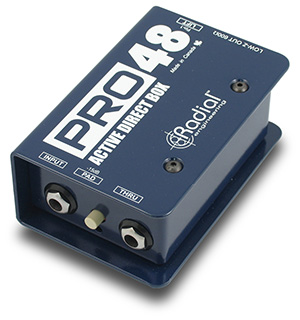
That’s why the active model I recommend is the cheaper of the two, the Pro 48.
Although powered via phantom power (48 volts, via your interface for example), it has a “Ground Lift” switch that allows you to block the grounding and thus avoid ground loops.
It is characterized by low distortion and a very good dynamic range, which makes it quite versatile in my opinion.
Ideal for recording all your passive instruments in your home studio 🙂
Compare the price at: Thomann Woodbrass
However, if you have a slightly larger budget, don’t hesitate to lean towards the J48. It has a few more buttons (high-pass filter, phase inversion, mono summation) that will likely be useful in the future.
Compare the price of the J48 at: Thomann Woodbrass
And for stereo instruments?
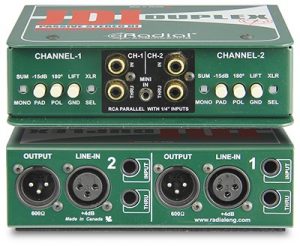
A number of situations may require you to use DI boxes for a stereo input signal.
I am particularly thinking of keyboards, which often have a left output and a right output.
Of course, there are also DIs suitable for this type of configuration, which are a bit more expensive. Here are the ones I recommend:
Passive Stereo DIs
- JDI Duplex (equivalent to the JDI): Thomann Woodbrass
- Pro D2 (equivalent to the PRO DI): Thomann Woodbrass
Active Stereo DIs
(At the time of writing this, there is no stereo equivalent to the Pro48.)
In summary
There you go, we have covered how direct boxes work and the models suitable for both home studios and live performance.
Even though I provided some technical details for you to understand well, the choice is ultimately not very complicated:
- Active instruments ⇒ Passive DI box
- Passive instruments ⇒ Active DI box
If after this you still have questions, feel free to leave a comment just below, and I will respond as soon as possible 🙂