
Line Level, Mic Level, Instrument Level…
Or Line Level, Mic Level, and Instrument Level in English…
When working with audio equipment, especially our famous audio interfaces in the studio and home studio, we are constantly faced with a whole vocabulary around signal level — vocabulary that can indeed be a bit tedious at first.
The fact is that understanding what these audio levels correspond to is particularly important: if you connect two devices incorrectly, you can easily damage one of them or get recordings with too much background noise.
Through this article, I propose to demystify these concepts so that you have all the necessary information to work without encountering problems in your studio.
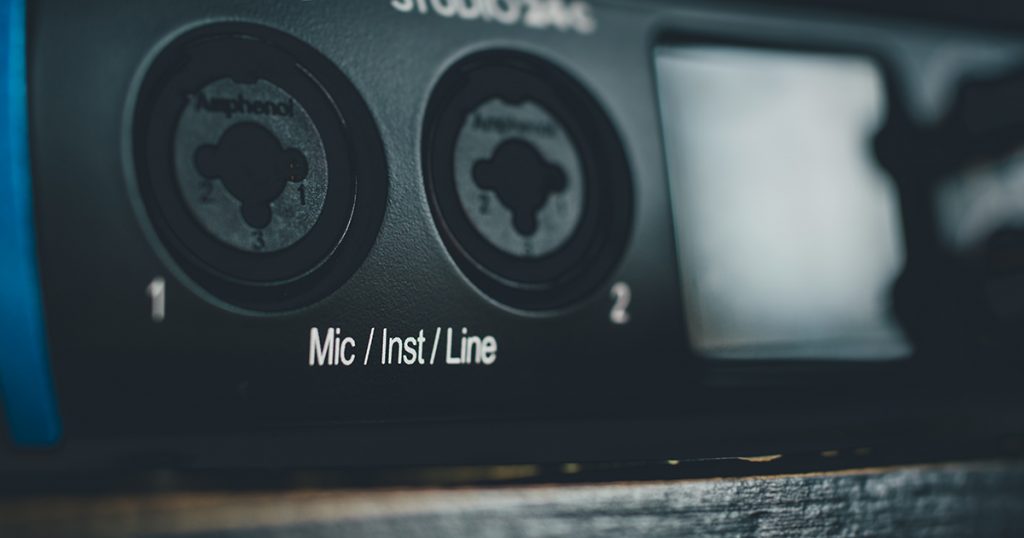
Mic Level
The mic level, as its name indicates, is the signal level generated by a microphone.
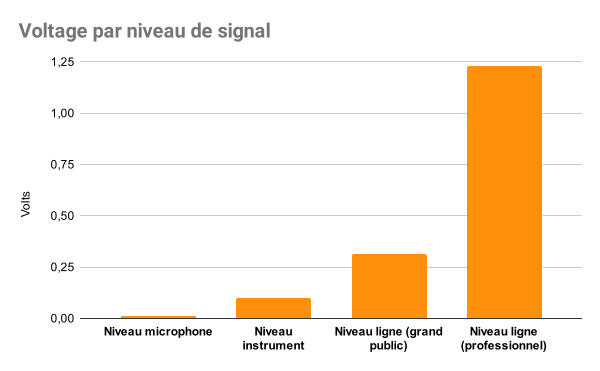
As one might expect, this electrical signal is extremely weak: on average, it is between -60 dBV and -40 dBV, or between 0.001 and 0.01 volts.
That’s really not much.
(We’ll talk a bit more about this unit called dBV later).
Of course, the signal level will depend on the sensitivity of the microphone and the volume of the sound source: the louder you speak into your mic, the higher the electrical signal coming out of it.
In any case, the signal will always remain very weak: this is why we connect our microphones to preamps to boost the signal from a so-called mic level to a line level.
Often, in home studios, we use the preamps already integrated into our audio interface.
Cables with XLR connectors are most often used to connect the mic to the preamp.
Instrument Level
The instrument level corresponds to the level of the electrical signal coming from guitars and bass guitars.
This is a signal that is between the mic level we just talked about and the line level.
Of course, it all depends on the pickups mounted on the instrument (active pickups, passive pickups) — but on average, we can consider that signals at instrument level are between 0.1 and 0.2 volts.
Through an impedance adjustment (for example, using a DI Box) and then using a preamp, we again boost the signal from instrument level to line level to be able to work with it in the studio.
In terms of cables and connectors, these are of course TS jacks that are most often used to carry signals at instrument level.
Note: due to the differences in level and impedance between instrument inputs and microphones, it is not advisable to connect a mic to a guitar input.
Line Level
Is it good, I haven’t lost you yet? 🙂
Good, because we’re going to move on to a slightly more complicated part. That said, I will do my best to simplify the topic as much as possible.
Promise!
Line Level, Less Known in Home Studio
The line level, is the highest level you will work with in your studio (except for the volume level in your speakers, but that’s another topic).
In other words, it’s also the level at which you need to work once the recordings are done.
But paradoxically, it’s a level that is a bit less known to beginners in home studio since they don’t always need it.
We sometimes wonder what this line in input is for that we don’t use…
Let me explain:
When you record your guitar by plugging it into your audio interface, the level is converted to line level — as we saw a little earlier. However, you don’t really see this line level: it stays in your interface and is sent to your speakers or to your converter, which will translate the signal into a digital signal for your computer.
In other words, you are using the line level without knowing it.
However, from the moment you add an external preamp or, for example, an effects rack (reverb, compressor…), that’s when you start working with the line level yourself.
So what is line level?
The line level is simply the electrical level at which we will work with our audio signal once it has been preamplified by a preamp:
- it’s the level at which the signal exits the preamp;
- it’s the level that comes out of most synthesizers;
- it’s the level that the analog-to-digital converter expects to convert the sound into a form understandable by your computer;
- it’s the level that the digital-to-analog converter reproduces when it converts signals coming from your computer;
- it’s the level expected by the power amplifier integrated into your speakers (or external, it’s the same);
- and finally, it’s the level expected by most hardware devices used to manipulate audio signals (notably compressors and EQs in studios).
A bit of history: the term “line” refers to “telephone lines”. Indeed, at the beginning of the 20th century, the level of these telephone lines was around 1 volt.
The line level is much stronger than the instrument level or the microphone level that we discussed at the beginning of the article.
It is indeed around 1 volt, potentially 1000 times stronger than the mic level.
The consequence is relatively obvious: it is not advisable to connect a microphone to a line input, as the signal would be too weak and drowned in background noise.
Conversely, you should avoid connecting a line level output to an input expecting a weaker signal (line level or instrument level): the signal would be too strong, which would cause distortion or could damage your equipment.
Note that this time, the connectors will not provide you with information: a signal at line level can very well be carried by XLR, Jack TS/TRS, or RCA cables.
In fact, there are two different “line levels”…
To complicate matters, there are two types of line level:
- the “professional” level, also called +4 dBU
- the “consumer” level, also called -10 dBV
Different uses…
You will find the +4 dBU level on most studio equipment sold today: preamps, audio interfaces, analog compressors, mixing consoles…
The -10 dBV level, on the other hand, is found more on less professional equipment like CD or DVD players, as well as on some effects racks for the studio (I am thinking particularly of the Midiverb and Microverb from Alesis).
Some audio interfaces and mixing consoles also have the ability to work with both +4 dBU and -10 dBV signals, which can be handy depending on the equipment you have available.
Different references…
At first glance, one might think that there is a 14-decibel (dB) difference between +4 dBU and -10 dBV.
Unfortunately, this is not the case.
That would be too simple, wouldn’t it?!
In fact, the two units, dBU and dBV, do not have the same reference point.
In other words, 0 dBV is not equal to 0 dBU:
- 0 dBV corresponds to 1 volt, regardless of the load impedance;
- 0 dBU corresponds to 0.775 volts, regardless of the impedance again.
In other words, they are two different units even though they look similar.
I won’t go into the details of the mathematical calculation, but the difference between the professional level +4 dBU and the consumer level -10 dBV is actually around 11.78 dB.
As an illustration, the table below will allow you to compare dBV, dBU, and Voltage:
| Level in dBU | Voltage (RMS) | Level in dBV |
|---|---|---|
| +4 | 1.228 V | +1.78 |
| +2.2 | 1 V | 0 |
| 0 | 0.775 V | -2.22 |
| -7.78 | 0.316 V | -10 |
To go further: if you are interested in the topic, want to delve deeper, and are an English speaker, feel free to check out this dBU/dBV converter and get the excellent book The Sound Reinforcement Handbook by Yamaha.
But above all, in French, I encourage you to watch the excellent video below from Studio Delta Sigma.
How to connect +4dBU to -10 dBV (and vice versa)?
If you send a signal at professional line level (+4dBU) to equipment expecting consumer line level (-10 dBV), the signal will be too strong and will likely clip.
To avoid this problem, you can lower the output level of your +4 dBU equipment (for example, if it’s a mixing console), or use a power attenuator like the Shure A15AS.
Conversely, if you want to connect equipment operating at -10 dBV to a line input expecting a +4 dBU signal, you will lack power.
To avoid this problem, you can amplify the signal at the +4 dBU device (but background noise will then increase), or use specialty boxes like the Radial Engineering J+4.
In conclusion
There you go, you now know everything there is to know to confidently use your signals at microphone, instrument, or line levels in your home studio!
Feel free to ask your questions in the comments if you still have doubts 😉