
Are you looking for an affordable dynamic microphone? Or perhaps a high-end one?
There is one, of course, that you should have in your collection. A must-have.
But there are also many models, associated with all sorts of prices and qualities… which certainly does not simplify the choice! 🙂
So, to help you in your search (whether for your studio, home studio, or even for the stage), I have put together this list that includes 9 of my favorite dynamic microphones.
By the way, I took this opportunity to detail a bit about how dynamic microphones work and their uses — but feel free to scroll down a bit further in the article if you want to jump straight to the list of recommendations.
How do dynamic microphones work?
The operation of dynamic microphones is based on a simple electromagnetic principle, namely that if a magnet moves near a coil, the interaction of the two will generate an electric current.
Specifically, in our case and as you can see in the image below, a diaphragm is attached to a coil, which surrounds a magnet. When a sound wave reaches the diaphragm, it vibrates, causing the coil to move. Through interaction with the magnetic field of the magnet, an electric current of variable intensity is created.
This is referred to as a “moving coil dynamic microphone.”

The output voltage of the electric current is low (lower than that of a condenser microphone, for example). Therefore, it is common to use a transformer to increase the voltage before the signal is sent to a microphone preamp.
When to use a dynamic microphone?
Advantages
The technology and circuits contained in dynamic microphones are relatively simple, which implies fairly low production costs. As a result, compared to condenser microphones, their price is much lower. Generally, below €500 — whereas a condenser mic can easily exceed €1000.
Moreover, they are often more robust, making them necessarily very good choices for live performance or if you need to move your equipment from time to time. This way, there’s less chance of breaking anything! 🙂
Finally, the great advantage of dynamic microphones is that they are “forgiving.” This means that their lower sensitivity will highlight fewer flaws than a condenser microphone. This is particularly important for vocal recordings, where the sound will often seem smoother on a dynamic mic than on a condenser.
Use cases
In the studio, there are of course no absolute rules regarding microphone choice: it’s a bit about feeling, or at least according to personal preferences.
However, since dynamic microphones can handle very high sound levels, they are part of the standard studio microphones for recording instruments with a high output level. Typically:
- guitar amplifiers;
- drums (kick drum, snare…);
- saxophones, trumpets…
On the other hand, with vocals, it’s a bit of a double-edged sword: on one hand, dynamic microphones will be more forgiving of singer flaws, but they will produce a less detailed sound. However, if you are recording rock or metal, don’t hesitate to try an SM57 or an SM7B — you will be surprised by the result.
Be careful of the necessary gain…
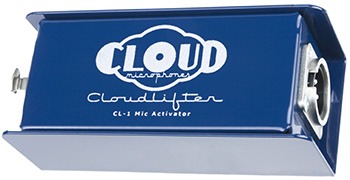
Similar to ribbon microphones, the output level of dynamic microphones is not always very high. Therefore, they require a preamp with significant gain.
This is particularly true for the SM7B and RE20 (and by extension the SM57) mentioned below, which require about 60 dB of gain to function properly — in other words, more than what is typically found on entry/mid-range audio interfaces.
Instead of pushing your preamps to the max, a simple solution is to use a Cloudlifter. That is, a small preamp with no settings but equipped with a particularly efficient circuit, which allows you to add +25 dB to your signal.
Of course, this type of equipment will not be necessary for all dynamic microphones, but it remains a useful tool that will help you achieve precise and high-quality sound!
► See the current price of the CL-1 on: Thomann Woodbrass Amazon
There you go, you now know everything about dynamic microphones — it is now time to move on to my selection 🙂
1. Shure SM57
 Brand: Shure
Polar Pattern: Cardioid
Frequency Response: 40 Hz – 15000 Hz
An absolute reference among dynamic microphones — used by both Bono and Björk, and since 1965 by the White House.
No matter which studio you go to, you will always find one of Shure’s famous SM57s. And it’s not by chance: this truly affordable mic stands out for its durability (even with heavy use) as well as its ability to brilliantly record almost any instrument: electric guitar amps, vocals, brass, drums.
Able to handle high sound pressure levels, it effectively adapts to all kinds of uses, each time bringing its recognizable character marked by a boost in frequencies around 6 kHz followed by a gradual filtering of frequencies above 10 kHz.
If you don’t have one yet, you know what you need to do: the SM57 is simply essential ! 🙂
Note: for maximum quality recording, pair the SM57 with a preamp that has significant gain or with a Cloudlifter (see just above)
► See the current price of the SM57 on: Thomann Woodbrass Amazon
2. Sennheiser E906

Brand: Sennheiser
Polar Pattern: Supercardioid
Frequency Response: 40 Hz – 18000 Hz
With the E906 from Sennheiser, we have a dynamic mic that is less versatile than the SM57 but still quite interesting. Coupled with a very reasonable price for its quality, it responds well to transients and high volume levels.
As its shape may indicate, it is indeed clearly specialized in capturing guitar amps: just let it hang in front of the amp while holding it with the cable. Since the microphone is relatively light but remains very sturdy, there is absolutely no risk. On the contrary, positioning it will be easier.
However, although it is not its primary use, it remains completely usable on other sound sources such as percussion (toms and snare drum for example) or brass.
► See the current price of the E906 on: Thomann Woodbrass Amazon
3. Beyerdynamic M201TG
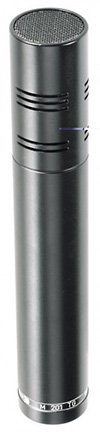
Brand: Beyerdynamic
Directivity: Hypercardioid
Frequency response: 40 Hz – 18000 Hz
The M201TG from the German brand Beyerdynamic is a fairly classic, very reliable, and quite sensitive mic. It is characterized by a natural, smooth sound, and in general, it is much more detailed than what most other dynamic microphones produce.
Sometimes wrongly overlooked in favor of an SM57, its small size makes it quite practical to position.
It will also prove to be very versatile for sound recording, as it can easily be used for percussion (it is regularly seen on snare drums or hi-hats), brass, electric guitar amplifiers, and even for vocals.
A good dynamic microphone!
► See the current price of the M201TG on: Thomann Woodbrass Amazon
4.Beyerdynamic M88TG
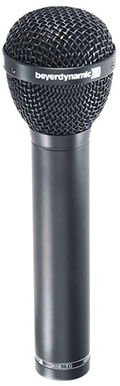
Brand: Beyerdynamic
Directivity: Hypercardioid
Frequency response: 40 Hz – 18000 Hz
The M88 is a famous dynamic microphone, introduced to the market in 1962. The TG (Tour Group) version, which is the one currently marketed, mainly differs from the old one by its now sturdier grille.
This mic produces a sound with body and responds very well to transients, while remaining natural and smooth.
Versatile, it is regularly found on kick drum recordings due to its frequency spectrum marked by a clear amplification of lows and highs (2-15 kHz). In general, it will be particularly useful for recording instruments for which low-end response is important.
► See the current price of the M88TG on: Thomann Woodbrass Amazon
5. Telefunken M80

Brand : Telefunken
Polar Pattern : Supercardioid
Frequency Response : 50 Hz – 18000 Hz
The Telefunken M80 is designed for vocals, which it reproduces very well and with more detail than a Shure SM57 would. Therefore, it is not the most versatile dynamic microphone, but it is heard quite regularly on snare drum recordings (example: 21st Century Breakdown by Green Day).
Generally speaking, the sound is quite modern and has a “high-end” effect reminiscent of the style of certain condenser microphones. Additionally, a presence peak between 5 and 10 kHz will help your recordings stand out quickly in the mix and place them forward in the stereo image.
► See the current price of the M80 on : Thomann Woodbrass Amazon
6. Heil Sound PR 30

Brand : Heil Sound
Polar Pattern : Cardioid
Frequency Response : 40 Hz – 18000 Hz
The PR30 from Heil Sound is a professional dynamic microphone designed by an American brand that is not necessarily the most well-known in France or in French-speaking countries but certainly produces high-quality equipment.
Articulate and warm, this microphone is characterized by very good reproduction of sounds coming from guitar amps. But it is equally effective for recording drums or vocals (perhaps due to its ability to reduce plosives and sibilance).
Be careful about positioning: even though its look might mislead us, the capsule of the PR30 is oriented forward, not towards the sides of the microphone. 😉
► The P30 is available in two colors :
7. Shure SM7B

Brand : Shure
Polar Pattern : Cardioid
Frequency Response : 50 Hz – 20000 Hz
The microphone of Michael Jackson on Thriller — but also on many other albums, particularly in metal for distorted vocals.
Robust and offering very good value for money, it is often used in radio and studio, most often for vocal or singing recordings but also occasionally for recording guitar amps.
Thanks to its cardioid directivity, it effectively rejects sounds coming from the back, making its positioning easier. Additionally, two buttons located at the back of the microphone allow for controlling (EQ filter) the lows and high-mids, providing increased flexibility.
However, it should be noted that the SM7B requires at least 60 dB of gain to produce good quality sound, so it is often necessary to use a Cloudlifter (see the paragraph on the subject at the top of the article).
► See the current price of the SM7B at: Thomann Woodbrass Amazon
8. Electro-Voice RE20
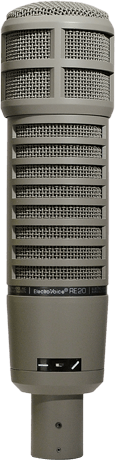
Brand: Electro-Voice
Directivity: Cardioid
Frequency response: 45 Hz – 18000 Hz
Even though its design is somewhat debatable in my opinion, the Electro-Voice RE20 is one of the high-end dynamic microphones.
It effectively rejects sound from the sides, allowing for quality recordings with depth, thanks to excellent frequency reproduction (especially the lows) and minimal off-axis coloration.
Equipped with an integrated low-cut filter and an internal pop filter, it is well-suited for recording vocals, as well as guitar amps (particularly for rock and metal).
However, it is worth noting that the RE20, like the SM7B above, requires about 55/60 dB of gain from the preamp to function properly.
Without a doubt, one of the best dynamic microphones!
► See the current price of the RE20 at: Thomann Woodbrass Amazon
9. Sennheiser MD 441
Brand: Sennheiser
Directivity: Supercardioid
Frequency response: 30 Hz – 20000 Hz
The Sennheiser MD 441 is a very high-end dynamic microphone (not surprising given the price) with an instantly recognizable, somewhat retro shape that is really nice.
Very sensitive, it reproduces frequencies quite linearly, with a soft and neutral sound — but detailed and dynamic. The mids are clear and the lows, very well rendered, remain adjustable if needed thanks to the integrated 5-band equalizer.

Adaptable to many situations, the MD 441 excels on snare drums and guitar amps.
So yes, it is one of the most expensive dynamic microphones, but the quality is definitely there!
► See the current price of the MD 441 at: Thomann Woodbrass Amazon
To go further
Indeed, there is an infinite number of dynamic microphone models. However, those present in this list are reliable choices that have proven themselves, and they should help you cover all the uses you can imagine.
However, do not forget that in some cases, other types of microphones will help you go further. For more information, visit my detailed studio microphones guide.