
Which ribbon microphone should you have in your collection?
Let’s face it, ribbon microphones have something “extra” compared to other studio mics. Perhaps it’s their warm sound, often a bit vintage? Or maybe just their price, which is generally much higher than dynamic or condenser mics?
In any case, they are part of the usual arsenal of studios — and an increasing number of home studios as models and brands develop.
To guide you in your search, and to prevent you from spending hours comparing microphones only to realize that they are not as good quality as you initially thought, I have put together this list of my 6 favorite ribbon microphones.
Generally speaking, I have tried to offer models for all budgets. As a result, some are expensive, but they are of such quality that I couldn’t bring myself to leave them out…
A final word: if you have any questions after reading this article, if you need advice, feel free to leave a comment and I will respond quickly 🙂

1924 (A Bit of History)
It was in 1924 that Walter H. Schottky and Erwin Gerlach co-invented the ribbon microphone — and in the same breath, the ribbon speaker, through a simple inversion of the circuit.
 Operation of Ribbon Microphones
 Operation of Ribbon Microphones
The principle is quite simple: a thin, generally corrugated (wavy) metal ribbon is positioned between two magnets with reversed polarity.
When a sound occurs, it vibrates the ribbon which generates a certain voltage due to the presence of the magnetic field. This signal is then transmitted to the rest of the circuit via the contacts located at the ends of the ribbon.
You may suspect: this type of microphone is of course very fragile, as the ribbon is generally between 2 and 4 microns! Therefore, they must be handled with care, and it is advisable to avoid placing them too close to loud sound sources.
Use of Ribbon Microphones
Ribbon microphones tend to deliver a rather natural, warm, even vintage sound, as they poorly reproduce frequencies above 10 kHz. Nothing to do, for example, with condenser microphones.
Moreover, almost all of them have a polar pattern of “figure 8” which necessarily contributes to this natural aspect.
In terms of use, they are often employed in situations where it is important to best reproduce the dynamic and harmonic variations of the instrument while having a silky sound.
Typically, for sound recordings:
- of acoustic instruments;
- of vocals;
- of drum overheads;
- of guitar amplifiers;
- of brass instruments.
That said, nothing prevents you from using them in other configurations: it is always important to experiment. For example, even though they are not part of the vocal microphones that I recommend by default, it is completely possible to use them for this type of application 🙂
MXL R144

Brand: MXL
Type: Ribbon
Polar Pattern: Figure 8
In the entry-level range, the R144 from MXL stands out hands down.
Indeed, despite its very low price, it is a serious microphone that will undoubtedly be a good starting point for any home studio user looking to delve into low-cost ribbon microphones.
The microphone has a compact body with a design mixing dark purple and chrome, which I find quite nice and well done.
The 47 mm long and 1.8 micron thick ribbon produces a rather soft and warm sound, although the mids can be a bit piercing — which can be corrected with an EQ.
In short, an excellent microphone for the price.
► See the current price at: Thomann Amazon
Avantone CR-14

Brand: Avantone
Type: Double Ribbon
Directivity: Figure 8
A bit more expensive but still affordable for a ribbon microphone, the Avantone CR-14 is a very good microphone, of the same quality as the rest of this brand’s range.
The design is quite original, vintage, and if you like the color, it will likely look great in your home studio.
Very effective on overhead drum recordings and guitar amplifiers, it has a warm, silky, and natural sound.
Probably due to its double ribbon, it is also more sensitive than many other ribbon mics, allowing it to adapt to many recording situations.
► See the current price at: Thomann Amazon
sE Electronics Voodoo VR1

Brand: sE Electronics
Type: Ribbon
Directivity: Figure 8
The Voodoo VR1 lives up to its name, as there is something magical about this microphone.
Indeed, equipped with a 2-micron ribbon and a custom transformer, it is designed around a specific technology that provides a clear and balanced response in the highs up to at least 18 kHz.
It is the only one on this list with this particularity, while still maintaining the warm sound that one seeks when choosing a ribbon microphone. Very effective on vocals, it allows for dense and detailed recordings, with body.
Its relatively accessible price makes it very interesting for home studios, for those looking for a ribbon microphone with a somewhat specific character.
► See the current price at: Thomann Amazon
Beyerdynamic M 160

Brand: Beyerdynamic
Type: Double Ribbon
Directivity: Hypercardioid
Ideal for miking guitar amps, this mic has been used by Eddie Kramer, the famous sound engineer, to record albums by Led Zeppelin and Jimi Hendrix — to say the least, it has proven itself.
The specificity of this mic is that it has a hypercardioid directivity, and therefore does not pick up sounds from the rear.
Because of this, along with a slight boost around 5 kHz, it gives a sound that is a bit tighter, a bit more compact than the other mics on this list, with increased presence.
► See the current price on: Thomann Woodbrass Amazon
Royer R-101

Brand: Royer
Type: Ribbon
Directivity: Figure 8
The little brother at a lower price of the famous R-121 presented below, the R-101 is an excellent quality microphone assembled in the United States by Royer, the most famous brand of ribbon microphones.
It has a smooth sound completely devoid of those unnatural resonances that can sometimes be found in lower-end models. In addition, it has a certain presence in the highs that will allow this mic to be used in many situations.
Its rounded response in the mid/bass-mid range classifies it in the category of effective microphones for recording electric guitars.
A very good investment for your home studio, for sure.
► See the current price on: Thomann Woodbrass Amazon
Royer R-121

Brand: Royer
Type: Ribbon
Directivity: Figure 8
An absolute reference for ribbon microphones.
Sure, the price is high – and probably out of reach for many home studios. That said, it was impossible for me to create this list without mentioning it given how famous it is.
Like the R-101 mentioned just before, it proves to be particularly effective for recording guitar amps, capturing their sound in a very natural way with a general softening of the highs.
Very detailed in the mids, the R-121 is frequently paired with an SM57:
- the first provides warmth and body
- the second helps the recording cut through the mix by giving it more aggression.
One of the best ribbon microphones, without a doubt.
► See the current price on: Thomann Woodbrass Amazon
For a little more gain…
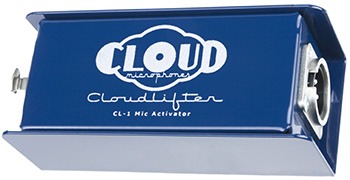
The downside of passive ribbon mics is that their output level is generally quite low.
As a result, it is important to have a quality microphone preamp with a large amount of gain available to ensure ideal recording.
Typically, the preamps of “entry-level” audio interfaces like the Focusrite Scarlett 2i2 will often be a bit weak.
If you find yourself having to turn them all the way up to achieve a decent recording level, I recommend getting a Cloudlifter CL-1 instead.
In a nutshell, it’s a kind of effects pedal that will boost your microphone signal by +25 dB. It’s quite convenient to use, as it doesn’t need to be plugged into the mains: it’s the phantom power from your audio interface that will allow it to function.
► See the current price at: Thomann Woodbrass Amazon
In conclusion
As you can see, ribbon microphones are generally quite expensive tools, but their rather unique sound qualities make them particularly interesting.
If I had to recommend just one from this list — and the choice is tough — it would undoubtedly be the R-101 from Royer, whose quality/price ratio is undeniably very high.
Continue reading: the Complete Guide to Studio Microphones.