
What is THE best microphone for recording vocals or singing?
Well, I can’t answer that question, because there isn’t just one.
In fact, in the studio equipment market, there are many microphone models.
Tens and tens of them.
So, whether you’re looking for a cheap microphone for your vocal takes or a high-end mic for ultra-quality singing recordings, how do you choose?
Well, the answer is simple: by selecting a model that can be considered a safe bet.
Typically, one of the microphones listed in this article.
Important note: if you’re looking for a live singing microphone, click here to see my selection (I will write a dedicated article soon).
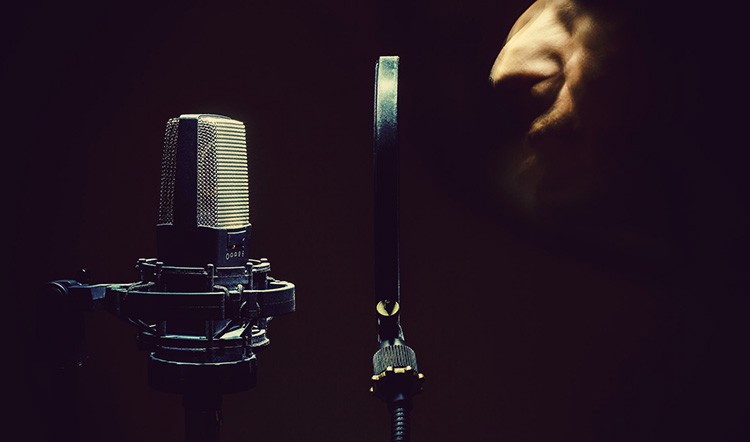
Because indeed, on this page, I have selected 10 of the best microphones for recording vocals or singing.
And as you may know (or not), Projet Home Studio specializes in everything related to home studio recording, I chose not to present you with overpriced microphones.
Because sure, you can get a microphone like this one, which as you will see is overpriced, and your voice will probably sound good.
But in a typical home studio context, no one has that budget (I wish you did, though :D)!
So I preferred to make a list that is truly useful rather than recommend inaccessible items.
(Note that, for easier navigation, the microphones are sorted by price.)
However, I have included at the end of the article a few more expensive microphones as a bonus, which may interest you if your budget is high or if you want to go further with your equipment.
Note: Keep in mind that there is no absolute studio microphone. Depending on the singer, the same microphone can sound better or worse, and it’s generally unpredictable (which is not always mentioned when selling microphones).
However, if you go for a model that can be considered a safe bet, there shouldn’t be too many issues — especially if you apply the right recording techniques.
With that said, here are my microphone recommendations for singing. If you have any questions after reading this article, feel free to leave a comment — I will guide you to make the right choice! 🙂
1. Audio-Technica AT 2020
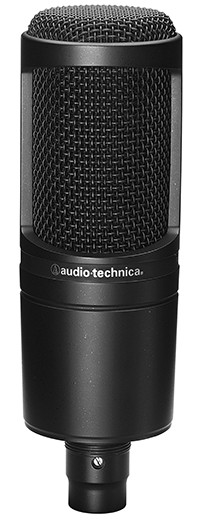
Brand: Audio-Technica
Type: Condenser (Large Diaphragm)
The AT2020 is a very popular microphone in home studios for two reasons:
- on one hand, its price is very low (below the €100 mark);
- but in addition, the quality/price ratio is really excellent.
Indeed, although it is a small microphone, the AT2020 offers a pleasant sound with rather smooth highs.
Sure, it’s not perfect, and there may be a slight background noise, but honestly, it’s an excellent microphone that I find is perfect for beginners or people with tight budgets who still want quality recordings.
Indeed, it has a fairly flat frequency spectrum, except for a peak around 8/10 kHz that helps open up the sound by adding presence.
In short, an excellent microphone for singing at a very reasonable price.
Note that I sometimes recommend, particularly in my personalized assistance services, the model just above, namely the AT2035, which is a bit larger, a bit more sensitive, and has a little less background noise.
► See the current price on: Amazon Thomann Woodbrass
2. Shure SM58
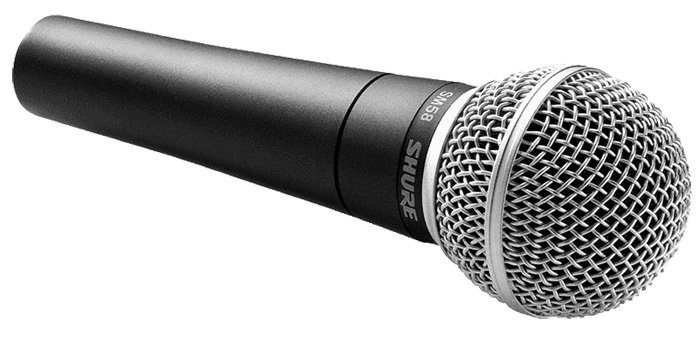
Brand: Shure
Type: Dynamic
A bit difficult to make a list of microphones for singing without mentioning the SM58 (not much different from the SM57 by the way). Certainly, it is more often used for concerts, but many artists record with it in the studio, such as Björk or U2.
This mic is a legend, a true industry standard.
It has a somewhat dark sound, in any case not very open, and dampens bass below 100 Hz — but it can do the job very well if you are a beginner or if you are recording voices where a very high level of detail is not essential (like hard rock vocals, scream in metal, etc).
In short, if you are looking for a first microphone that is easy to use and has proven itself, the Shure SM58 could be an interesting option.
► See the current price on: Amazon Thomann Woodbrass
3. RØDE NT1-A

Brand: RØDE
Type: Condenser (Large Diaphragm)
A microphone highly sought after by beginners who want to record themselves because it is sold with a complete pack including pop filter and shock mount. However, it is by no means a toy: it is really a good mic.
It is known for good sound quality and low background noise. A small bump around 150 Hz will give some warmth to your recordings, while the peaks in the highs will help your voice stand out during mixing.
As for the drawbacks, I find the microphone a bit too bright, and slightly aggressive on certain voices. That said, you can really do something interesting with it, as you will hear in the video example below, which I find very telling.
A good choice for beginners looking for a versatile microphone that gets the job done without going over an unreasonable budget.
► See the current price on: Amazon Thomann Woodbrass
4. Aston Microphones Origin

Brand: Aston Microphones
Type: Condenser (Large Diaphragm)
I often recommend the Origin for vocal recording because even though its price is accessible, it is a microphone that offers an impressive quality/price ratio.
Made in Great Britain, it stands out primarily for its distinctive industrial design (which will definitely look great in your studio, at least if you like the style) and very solid construction (it won’t get damaged if it falls).
In terms of sound, the recordings are quite detailed and natural, albeit a bit dark.
Clearly, the Aston Origin has nothing to envy from models five times more expensive: vocal captures are warm and powerful, with high frequencies always smooth and pleasant.
It’s actually a microphone that I used for a long time for my own voice on my YouTube channel.
A nice gift for your home studio? 🙂
► See the current price on: Amazon Thomann Woodbrass
5. Beyerdynamic M90 PRO X

Brand: Beyerdynamic
Type: Condenser (Large Diaphragm)
A really little-known option, but having had the opportunity to test it for a YouTube video and really appreciating the quality/price ratio of the microphone, it seemed relevant to mention it in this article.
If you want to see & hear all that, here is the video in question:
Indeed, the M90 PRO X from Beyerdynamic didn’t really receive much marketing when it was released, and therefore it is not talked about much.
Yet, the sound is warm, the highs are pleasant, and for the price, you get sounds that are perfectly usable in a home studio context. I’m almost surprised that the microphone isn’t more expensive.
► See the current price on: Amazon Thomann
6. LEWITT LCT 440 PURE

Brand: LEWITT
Type: Condenser (Large Diaphragm)
It is not always necessary to spend a fortune on a microphone to achieve quality results.
In a home studio context, the LCT 440 Pure from LEWITT (a rising Austrian brand) is an interesting option.
The sound is clear, quite precise, and of good quality.
The highs, which are often the weak point of entry-level microphones, are rather natural, which is appreciated. However, they are emphasized, giving a very modern voicing to recordings made with this microphone (but it all depends on the original voice).
It is therefore better suited for voices that are not too bright to begin with.
Finally, it is worth noting that the microphone comes with a small pop filter and an appropriate mount, which is a significant plus (especially for the price).
Definitely worth a close look…
► See the current price on: Amazon Thomann Woodbrass
7. Warm Audio WA-47jr

Brand: Warm Audio
Type: Condenser (Large Diaphragm)
I am one of those who quite like Warm Audio products, even regularly using one of their preamps for my microphones, the TB12.
And among their wide range of microphones, I find that the WA47-jr is particularly suitable for vocal or voice recording.
Especially in a home studio context, which seems to be the intended use for this mic given the price (just below €300 at the time of writing).
In concept, the microphone is inspired by the famous Neumann U47 of the past. Although the sound is different, it is still a nice microphone with a good quality/price ratio, with selectable directivity (cardioid, omnidirectional, figure-eight) and integrated FET amplification (no transformer).
The sound is rich, quite warm, and at the same time relatively flat (except for some boosts in the highs). Since the recordings are of good quality, you can still adjust your signal as you wish during mixing with EQ or other effects, without bringing out any particular issues.
In terms of quality/price ratio, I even think we are looking at something better than its big brother the WA47 (which, being tube-based, justifies the significant price difference).
► See the current price on: Amazon Thomann Woodbrass
8. Shure SM7B

Brand: Shure
Type: Dynamic
Simply THE dynamic microphone to own.
Used by Michael Jackson on the album “Thriller” in its previous version (“SM7”, almost identical), it is particularly effective for male singers (but not exclusively of course) and is often used by extreme metal singers.
Cardioid, it rejects sounds coming from the back very well.
This is why I recommend it for your home studio: if you have a room with a lot of reverberation, and you do not wish to implement acoustic treatment, this is probably one of the microphones that will give you the best sound (even though most of the time, I still prefer condenser microphones).
The sound is smooth, but it is possible via a slider to boost the mids for more aggression, in order to achieve a sound that cuts through the mix a bit more easily.
However, be careful: for it to work under good conditions, you will need a mic preamp with at least 60 dB of gain. If this is not the case, you can do like many people and place a Triton Fethead just before (it is a simplified preamp using phantom power to boost the signal cleanly, that is to say without adding too much background noise).
► See the current price on: Amazon Thomann Woodbrass
9. AKG C214

Brand: AKG
Type: Condenser (Large Diaphragm)
Sometimes considered a much more affordable “version” of the famous C414 (which costs around €1000), the C214 is a microphone that is quite different from its big brother.
It has a detailed sound, associated with a fairly flat frequency spectrum, and does particularly well on vocal recordings.
As with most other condenser microphones on this list, there is a peak around 10,000 Hz to brighten the sound. A slight dip around 1500 Hz softens the voice.
In the low frequencies, it provides a rather powerful sound, with real density, reminiscent of what can be obtained on much more expensive microphones.
Moreover, the capsule has a dedicated suspension integrated into the microphone, which significantly reduces mechanical noise.
It is also worth noting: the C214 has a -20 dB pad, which will allow you to record loud sound sources if needed.
In short, probably one of the best microphones for singing in a (home) studio under the €500 mark.
► See the current price on : Amazon Thomann Woodbrass
10. Neumann TLM 102 / 103
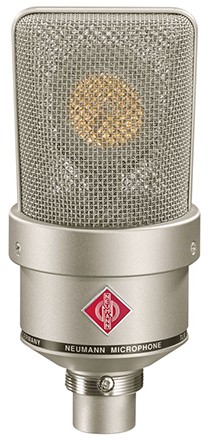
Brand: Neumann
Type: Condenser (Large Diaphragm)
Two suggestions in one for the last choice of this selection.
In fact, the TLM103 is often talked about, so I wanted to mention it here because it’s a good microphone. But the price is a bit too “premium” compared to the quality, I think.
While the TLM102 from the same brand, a bit less highlighted, is associated with a much more reasonable price and can allow a home studio owner to access a Neumann mic without exceeding €1000.
In terms of sound, both microphones sound good, but I have a preference for the TLM102. Certainly a bit darker, I also find it less aggressive. The TLM103, on the other hand, gives a more “finished product” and “modern” sound, which can work very well in rap productions, for example, but will often be a bit too frontal due to a marked presence in the highs.
► See the current price:
Bonus: 4 microphones for more “high-end” singing recording
To complete this article, I think it is interesting to look at some recommendations for more “high-end” microphones, starting from €1000 and above.
Even though for a beginner these might not necessarily be relevant choices, having a very good microphone in your home studio can be a way to drastically improve your musical productions.
And this, even if you connect it to a small audio interface…
11. Mojave MA201 FET

Brand: Mojave Audio
Type: Condenser (Large Diaphragm)
Perhaps a slightly original choice in this selection: a Mojave microphone.
It is not very well known in France, but in fact, it is a brand owned by David Royer, who also manages the very famous Royer Labs ribbon microphone brand.
With the Mojave MA201, you have a microphone with a real character, very modern in sound and in the way the highs are presented.
There may be a bit of sibilance that comes out, but this is also related to the style, which is more frontal than other microphones.
An interesting choice if you want to have something original in your studio.
(Note that there is also a 301 FET version with several polar patterns)
► See the current price:
12. AKG C414 XLII

Brand: AKG
Type: Condenser (Large Diaphragm)
We talked earlier about the C214 from the same brand: this time, it is the big brother, the famous AKG C414 in XLII version, a modernized variant of the vintage C414.
In terms of sound, we are dealing with a microphone that I find has quite a bit of character: it highlights the highs in a pronounced way, which can be interesting especially on dark voices or to give a somewhat modern and open feel to recordings.
Moreover, since the microphone integrates 9 different polar patterns, it proves to be a versatile tool that will allow you to record other sources besides vocals, such as overhead drums or a piano.
Also note the presence of high-pass and low-pass filters, with different possible settings.
► See the current price on: Amazon Thomann Woodbrass
13. Neumann TLM 49

Brand: Neumann
Type: Condenser (Large Diaphragm)
If you want to have a Neumann microphone in your studio, without going for prices like €2000 or more, I recommend taking a look (and a listen) at the TLM 49 from the brand, which is still quite a bit more performant than the TLM 102 / 103 we talked about earlier.
In the low frequencies, we find the pleasant and characteristic density of high-end microphones, and the highs are, I find, silkier and more controlled than on the TLM 103.
So yes, we are starting to get to a fairly high price, but it remains an interesting long-term investment for anyone looking for absolutely excellent sound quality for their vocal recordings (that said, keep in mind that the other, cheaper microphones in this article still allow for high-quality results).
► Compare prices for the Neumann TLM 49 on: Thomann Amazon Woodbrass
14. Neumann U87 Ai

Brand: Neumann
Type: Condenser (Large Diaphragm)
It’s hard to talk about high-end vocal microphones without mentioning the Neumann U87 Ai.
Even though it doesn’t sound at all like the vintage models (which are now overpriced), it is a legendary microphone with a warm and precise sound, very pleasant to listen to, and which generally integrates very well into mixes.
We are really talking about high-end here, and I find the microphone quite versatile in the sense that it can adapt to many voices.
However, the downside, if I dare say, is the price: we are clearly looking at a premium price, and even though the brand produces quality items, we know that we are paying a bit for the name “Neumann” on the microphone.
In any case, it can make a very nice object in a home studio that leans a bit towards the “pro” side!
► See the current price on: Thomann Woodbrass
To go further…
Having a good studio microphone is undoubtedly essential for recording vocals or voices of all kinds.
However, as I mentioned in the introduction, it is also important to record under the best possible conditions. This includes, in particular, using a room with properly controlled acoustics.
On this subject, I recommend reading my guide to acoustic treatment in the studio.