
In the studio or home studio, monitor speakers (sometimes referred to as “studio monitors”) are part of the essential equipment that everyone should have.
Without a good listening system that offers a neutral sound, your mixes will not be balanced and their flaws will stand out when you listen to them in your car or on another medium. For example, the bass may be too strong, the mids muddled, or the highs harsh.
To avoid this, the first step is to choose quality studio speakers like these that will help you make the best mixing decisions possible.
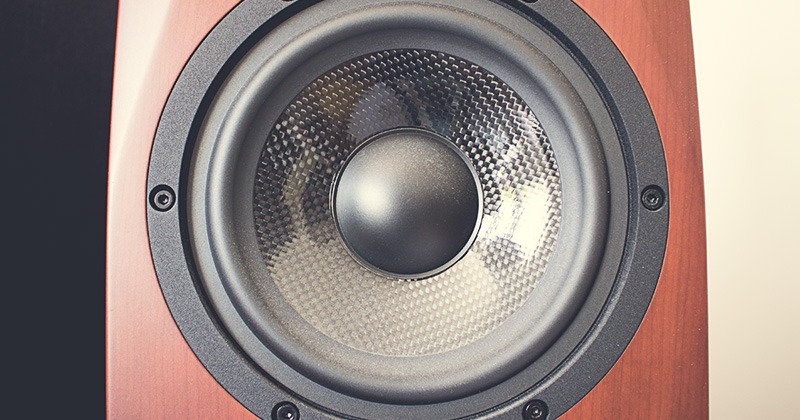
As always with studio equipment, there are many brands and many models.
There are inexpensive monitor speakers, and others that are more high-end.
Choosing a pair of speakers can quickly become a very complex — even exhausting — activity if the information collected is contradictory.
To guide you in your research, I have written this guide to concentrate as much advice as possible in one place to help you choose monitor speakers for your (home) studio.
Here is the content of this article:
- How to choose monitor speakers?
- The best monitor speakers (my selection)
- Comparison table of the best speakers
- Accessories for monitor speakers
- Getting the most out of your monitor speakers
- Monitor speakers FAQ
In summary…
If you don’t have much time, here are the 3 key suggestions from this article:
| Model | My opinion | Click to see the price |
|---|---|---|
 JBL 306P | If you have a very tight budget, this speaker can do the job even if it’s not perfect | Thomann Woodbrass Amazon |
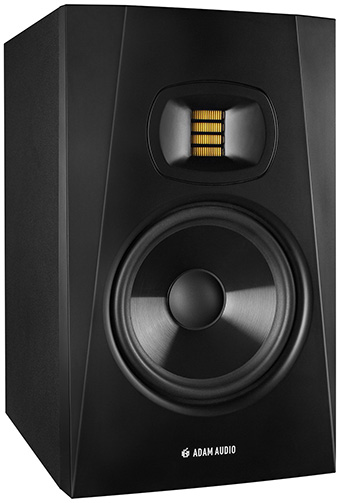 Adam Audio T7V | A choice with a very good quality/price ratio for beginners who still want quality sound. | Thomann Woodbrass Amazon |
 Adam Audio A7V | My favorite for home studios looking for professional quality speakers (this is the new version of the speakers I use, the A7X) | Thomann Woodbrass Amazon |
.tableauEntete.affLinkContainer a.affLink {display:block;}
How to choose monitoring speakers?
Before looking at my selection of the best studio speakers, I suggest we review the main characteristics to keep in mind to make a choice.
This will help you avoid unpleasant surprises…
The frequency range
By definition, monitoring speakers should be flat across the entire audible frequency spectrum (from 20 to 20000 Hz).
The goal, of course, is to facilitate mixing with speakers that do not color the sound and behave as neutrally as possible.
Logically, one of the first technical specifications to look at is the frequency range, which reflects the frequency range over which the speaker is supposed to be flat.
For example, if the model you are looking at indicates “47 Hz – 22000 Hz”, then it means that it is supposed to be flat over this range of values.
I say “supposed”, because in reality this is never the case: there are always small variations. That said, as long as these are within +/- 3dB, we can consider that it remains tolerable.
But then, how to use the frequency range to choose your speakers?
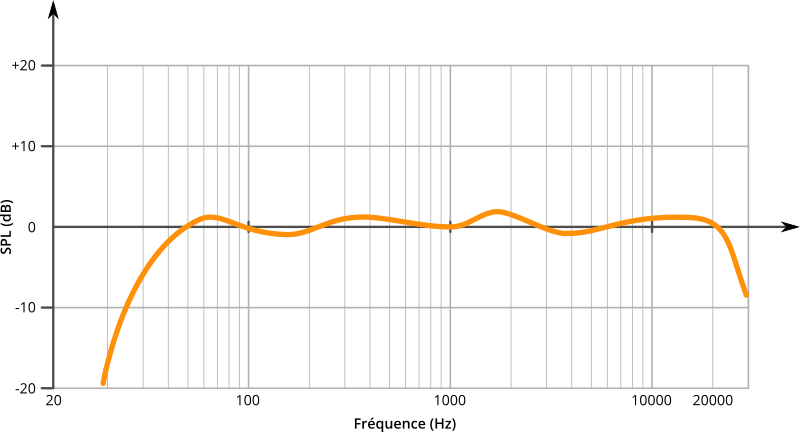
My advice is primarily to ensure that the speakers go down properly in the bass. Ideally, you need studio speakers covering at least the frequency range of 50 Hz – 20000 Hz.
If your speakers do not go down to 50 Hz, you will quickly be limited for mixing everything that is kick drum, bass, drum machine kick…
If your speakers go lower, for example down to 35 Hz, it will undoubtedly be more comfortable for mixing.
However, be careful, between a model that goes down to 42 Hz and another that goes down to 38 Hz, the difference will remain quite negligible.
Also note that, thanks to these sound properties, monitoring speakers are sometimes used as audiophile speakers as well.
Finally, if low frequencies are extremely important to you (for example in the case of electronic music or certain experimental music), one option will be to add a monitoring subwoofer to your speakers.
The size of monitoring speakers
Most studio speakers are composed of:
- a tweeter, which reproduces high frequencies and upper mids;
- a woofer, which reproduces low frequencies and lower mids.
The larger the woofer has a significant diameter, the more the frequency response of the speaker will go down into the bass (see previous paragraph). This size parameter is therefore important to consider when making a choice.

Without going into too much technical detail, here are my recommendations based on woofer size:
- 5″ — really limited, only if you have a small room and consequently you really don’t have the space for something larger, or if your budget really doesn’t allow you to get something bigger (and even then, I would rather advise waiting…);
- 6.5″ to 7″ — the standard size for home studios, widely sufficient for making good mixes (that’s what I use);
- 8″ — a slightly larger size for a more detailed response in the bass, but of course involving a higher price and larger speaker size.
In other words, if you are wondering which monitoring speakers to choose, and you absolutely need small monitoring speakers, of course take 5 inches — but if you really want to work under decent conditions, take 6.5 or 7 inches (there is, however, an exception to this rule in the list below, you will see 😉 ).
Remark: It is sometimes said that in a small room, you absolutely need 5-inch speakers. However, apart from potential space/size issues, there is no contraindication to having 7-inch speakers in a small room, quite the opposite.
The type of speaker
There are generally three types of monitoring speakers:
- Near-field speakers
- Mid-field speakers
- Main monitors
In a professional recording studio, you generally find a combination of several types.
For example, nearfield monitors coupled with main monitors: the former will serve for precision work, while the latter will allow you to hear globally what is happening in the mix, necessarily with a greater influence from the sound of the room.
In a home studio, you will simply need nearfield monitoring speakers.
Unless you have a room the size of a real studio, the other types of speakers will not be suitable.
Total Harmonic Distortion (THD)
The THD (Total Harmonic Distortion) is generally indicated in the technical specifications provided by the brands.
To put it simply, the initial signal sent to the speakers necessarily undergoes distortion, whether due to the amplification circuit or the construction of the speakers themselves.
The THD is generally low enough on monitoring speakers that it does not pose a problem — however, you can keep this measurement in mind, at least to compare models with each other.
Tweeter Technology
Each monitoring speaker manufacturer has developed its own technology for tweeters, these speakers dedicated to high-mids and highs.
While it is not really interesting to delve into an exhaustive comparison of the materials used, you will find two main types of tweeters: dome and ribbon.
Dome tweeters, in general, will sound a bit more lively, with an enhanced ambient effect.
Ribbon tweeters, on the other hand, will be much more analytical and precise, but sometimes a bit fatiguing.
So, if you plan to use your speakers for both mixing and listening to your music collection, I would tend to recommend dome tweeters. If, on the contrary, sound precision is important to you, go for ribbon tweeters.
Passive or Active Monitoring Speakers?
You may have heard about it: there are active monitoring speakers and passive monitoring speakers.
What is it about?
Specifically, for the speakers to generate sound, the signal sent to them must be amplified, via a power amplifier.
Active speakers already have an integrated amplification circuit, while passive speakers do not contain an amplifier.
For home studios, using active monitoring speakers will therefore be much more practical and largely sufficient. It is indeed preferable to invest in good active speakers rather than dividing your budget between passive speakers and an external power amplifier.
Front or Rear Ports? Or Not at All?
The openings made in the speakers to allow air to pass are called ports.
The purpose of these ports is to optimize pressure control inside the speaker while generating more bass around the resonance frequency (which depends on the dimensions of the port).

There is an ongoing debate about whether it is better to have a front port or a rear port.
There is no absolute answer. However, if you plan to place your speakers extremely close to a wall, I can only advise you not to have a rear port, to avoid unwanted disturbances. But if the port is a few centimeters away, there is no problem.
That said, in terms of acoustics, there is really no better position for the ports as low frequencies are not very directional and evolve at 360°.
Finally, some monitoring speakers do not have any ports at all. While this is supposed to be preferable in terms of sound, it should be noted that their price is generally higher.
Connections and Settings
Of course, all speakers have at least one input connection, located at the back and generally of the XLR and/or TRS jack type.
But except for the entry-level models, you will also find a number of settings that will be very useful for adjusting the sound to your room’s response, particularly in the bass and treble. This type of adjustment should be paired with a suitable acoustic treatment.
The price of monitoring speakers
Finally, price is obviously an important selection criterion.
To get good monitoring speakers for your studio, you should budget at least €300 for a pair (be careful, by the way, as studio speakers are generally sold individually).
Below this price, if you buy really cheap speakers, you won’t get much of interest.
You can of course buy second-hand, but you never really know how they have been used — especially since speakers are fragile items.
If your budget is not high enough, I recommend waiting a bit or investing in a good studio headphone that can be used for mixing or mastering.
👉 On this subject, I recommend checking out my selection of the best studio headphones.
My selection of the best studio monitoring speakers
I sometimes get asked the question “What are the best monitoring speakers for rock?” or “Which monitoring speakers to buy for rap?”.
So I will take this opportunity to clarify a fairly important point: there is no speaker model dedicated to a particular style.
Of course, the built-in technology will influence the sound, but there are no better speakers for electro or pop/rock: there are just speakers with a different sound.
Similarly, it would be quite difficult to make a true comparison of monitoring speakers. Because they are all a bit different.
That said, some models stand out for their quality and are therefore reliable choices.
Also, to guide you in your selection, I have consolidated this selection of the best monitoring speakers for the studio or home studio.
Note that all the speakers presented here are active monitoring speakers: no need to complicate the installation with amplifiers for no reason.
1. JBL 3 mkII
Compared to my price advice mentioned a few paragraphs above, the series 3 mkII from JBL (the new version of the JBL LSR you may have heard of) will be the only exception.
Indeed, if you are looking for “cheap” monitoring speakers, the LSR 305P, 306P, and 308P will undoubtedly be the best answer in terms of value for money.
While not excellent, they perform quite well and offer a very decent sound, relying on a 1″ soft dome tweeter and neodymium magnet.
The speakers in this series 3 mkII also include a number of useful settings that allow you to attenuate or amplify the bass and treble as well as select the input sensitivity (+4 dBu or -10 dbV), which is appreciated for the price.
A good entry-level choice.
👉 Click to compare prices:
- JBL 305P (5 inches) : Thomann Woodbrass Amazon
- JBL 306P (6 inches) : Thomann Woodbrass Amazon
- JBL 308P (8 inches) : Thomann Amazon
2. Yamaha HS

The Yamaha HS are a true reference in the entry-level monitoring speakers. Indeed, these models are very often the choice for beginners in home studio.
And rightly so: it is indeed a good option if you want studio speakers that are not too expensive.
The Yamaha HS, whose design resembles that of the famous NS10, are characterized by good definition in the bass and mids. The speakers are bi-amplified, meaning there is a separate amp for each cone which tends to eliminate interference.
At the back, there is a gain adjustment as well as a low-frequency compensation option (Room Control) and a high-frequency option (High Trim).
Made from assembled wood fiber panels, these Yamaha monitoring speakers offer deep and good quality sound. Certainly, it is not perfect, but for a beginner who wants to hone their skills in mixing & music production, it can do the job quite well.
For me, apart from the Adam T presented just after, they really have no competition in this price range.
👉 Click to compare prices:
- Yamaha HS5 (5 inches) : Thomann Woodbrass Amazon
- Yamaha HS7 (6.5 inches) : Thomann Woodbrass Amazon
- Yamaha HS8 (8 inches) : Thomann Woodbrass Amazon
3. Adam Audio Series T
The Adam Audio Series T is quite recent and stands out for its excellent value for money.
Three models are available: 5 inches, 7 inches, and 8 inches. The 5″ version was designed with smaller studios in mind, but generally, I would tend to recommend the 7″ version which will offer more flexibility.
For larger (home) studios, the 8-inch version can certainly make sense — I actually tested it in detail in this other article.
The woofer, made of polypropylene, is powered by a 50-watt Class D amplifier and is paired with a rear port. The U-Art ribbon tweeter, on the other hand, is coupled with an HPS waveguide that makes the dispersion more consistent and thus extends the size of the listening “sweet spot”.
Due to the ribbon tweeter, the sound is quite analytical and very clean, with a coherent and fairly precise response in the bass.
In short, a very good solution for mixing in excellent conditions despite a limited budget — it is indeed an excellent alternative to the Yamaha HS5/HS7 presented a bit earlier.
Clearly, my default recommendation for beginners on a limited budget.
👉 Click to compare prices:
- Adam T5V (5 inches) : Thomann Woodbrass Amazon
- Adam T7V (7 inches) : Thomann Woodbrass Amazon
- Adam T8V (8 inches) : Thomann Woodbrass Amazon
4. Focal Alpha EVO

The first positive thing about the Focal brand is that it is a French brand.
This is quite a good point (sorry in advance to readers from Belgium, Quebec, or elsewhere, if you do not associate with this remark 😉 ).
The Focal Alpha EVO series features 25 mm diameter inverted dome tweeters made of aluminum, which reproduce sound in a very detailed manner. The woofers are made from recycled carbon and are paired with two front ports that will suit users wishing to place them very close to a wall.
The whole system is bi-amplified thanks to a Class AB amplifier.
In terms of adjustments, there are several options:
- High-shelf filter at 4.5 kHz (+/- 3dB)
- Low-shelf filter at 250 Hz (+/- 6 dB)
- Input level adjustment (0 or +6 dB)
Additionally, there is an automatic standby mode, very convenient for saving energy.
Overall, the Focal Alpha monitoring speakers prove to be balanced and accessible at a very reasonable price considering the quality.
👉 Click to compare prices:
- Focal Alpha 50 EVO (5 inches) : Thomann Woodbrass Amazon
- Focal Alpha 65 EVO (6.5 inches) : Thomann Woodbrass Amazon
- Focal Alpha 80 EVO (8 inches) : Thomann Woodbrass Amazon
5. Dynaudio LYD
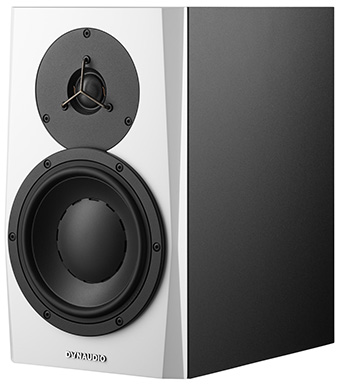
Manufactured in Denmark, the LYD series from Dynaudio, a renowned brand established since 1977, stands out primarily for its original and sleek design. You can immediately sense that you are in the good mid-range, even the beginning of the high-end.
The woofer is made of magnesium silicate polymer (MSP, a characteristic technology of Dynaudio speakers), and reproduces low frequencies very well. In fact, all frequencies are rendered very well on this series of monitoring speakers.
In terms of settings, there are some unique features, in addition to an automatic standby mode.
First of all, the LYD speakers include a Directivity Control button, which allows you to modify the speaker’s response depending on whether it is placed against a wall or not. Very practical.
Furthermore, they integrate a tilt-shift filter that allows you to adjust the sound balance (dark/neutral/bright) without affecting the phase of the signal. An alternative, in short, to the more classic low-shelf and high-shelf filters.
👉 Click to compare prices :
- Dynaudio LYD-5 (5 inches) : Thomann Woodbrass Amazon
- Dynaudio LYD-7 (7 inches) : Thomann Woodbrass Amazon
- Dynaudio LYD-8 (8 inches) : Thomann Woodbrass Amazon
6. Adam Audio Series A
The new version of the ones I use in my studio! 🙂 (see my test of my own Adam A7X speakers here)
The AV series from ADAM Audio is indeed the evolution of the famous AX series from the brand, which has received a number of awards, such as the Sound on Sound Awards, which attest to their quality.
In the bass range, the response is very precise thanks to the mineral fiber layered woofer. The sound is tight and always remains very balanced, with clear bass.
In the highs and upper mids, we get an ultra-analytical sound thanks to the X-Art ribbon tweeters (handcrafted in Germany) without it ever becoming fatiguing. In particular, you can very clearly hear the reverb behind the initial sound, instead of it blending indistinctly.
We will also appreciate, for those who want to customize the behavior of the speakers after measurements, the ability to really precisely adjust the frequency response and even load Sonarworks profiles via a built-in Ethernet port (everything is explained in my detailed test of the A7V).
In short, these ADAM Audio speakers are truly professional quality: very transparent, they excellently perform their role as studio monitors. They are my favorite model in the price range.
👉 Click to compare prices:
- Adam A4V (4 inches) : Thomann Woodbrass Amazon
- Adam A7V (7 inches) : Thomann Woodbrass Amazon
- Adam A8H (3-way version) : Thomann Woodbrass Amazon
7. Focal Shape

The Shape series from Focal, made in France, is relatively new but is already establishing itself as a reference for high-end monitoring speakers — as suggested by the real walnut veneer.
Indeed, it provides an extremely transparent sound, particularly thanks to the aluminum-magnesium inverted dome tweeter, designed with an “M” profile and coupled with a kapton support coil that minimizes distortion.
The Focal Shape monitoring speakers also do not have a port, but rather a dual passive radiator on the side allowing for very close positioning to the wall. Ideal, therefore, for small spaces as well as large studios.
Equipped with an automatic standby mode, like the Focal Alpha mentioned earlier, they provide an expanded lateral listening sweet spot thanks to their design.
To adjust the speaker response to the room’s acoustics, bass and treble level adjustments are available, as well as a 160 Hz filter.
Very good studio speakers!
👉 Click to compare prices:
- Focal Shape 50 (5 inches) : Thomann Woodbrass Amazon
- Focal Shape 65 (6.5 inches) : Thomann Woodbrass Amazon
8. Neumann KH120 II

The Neumann KH120 II, a newer version of the KH120 that has proven itself in many studios around the world, is another one of my favorites in terms of professional quality monitoring speakers.
In terms of woofer size, we are looking at 5.25 inches, which is certainly not very large… but these speakers are really the exception that proves the rule as they go down to 44 Hz — which is really sufficient for mixing in many musical styles.
(If needed, you can of course add a subwoofer.)
And in terms of sound, it is really very high quality: we have a good level of detail, and especially the way the sound information is presented allows you to make the right decisions during mixing.
If for example you are not very motivated by the ribbon tweeters of the ADAM Audio A7V, I think going for the Neumann KH120 II is a particularly interesting alternative.
Moreover, there is a bonus: the speakers integrate a DSP card, which allows you to partially correct sound defects related to the acoustics of your room using the MA-1 microphone and the corresponding software from the brand (at an additional cost). I had the opportunity to test the solution in a video on the YouTube channel.
👉 Click to compare prices: Thomann Woodbrass Amazon
9. Genelec Series 8000
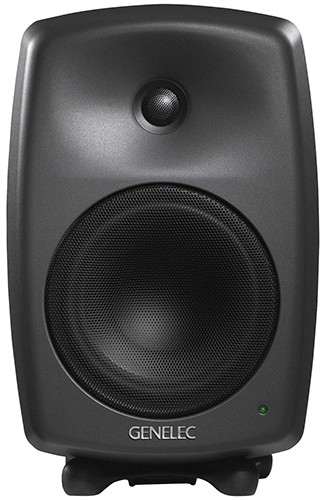
Genelec is clearly a high-end brand, which is a reference in the studio world.
Among the various offerings from the brand, the 8000 series corresponds to monitoring speakers that remain relatively affordable — at least compared to the more expensive models.
They are characterized by a metal dome tweeter (3/4 to 1 inch in diameter) including DCW technology, which smooths the off-axis frequency response for an expanded stereo image and listening sweet spot.
In terms of sound, the quality is truly impressive: one will notably notice the complete absence of distortion, even at high volumes.
Finally, a large number of controls are also available to adjust the speaker’s sound:
- High-pass filter for the bass
- “Desktop Control” to eliminate specific resonances when positioned on a desk
- Bass Tilt to control the bass below 800 Hz
- Treble Tilt to control the highs above 4 kHz.
In short, these are truly professional-quality monitoring speakers, but given the price, they can find a place among home studio enthusiasts with a large budget.
👉 Click to compare prices:
- Genelec 8030 CP (5 inches) : Thomann Woodbrass Amazon
- Genelec 8040 BPM (6.5 inches) : Thomann Woodbrass Amazon
- Genelec 8050 BPM (8 inches) : Thomann Woodbrass Amazon
10. Auratone 5C

It’s impossible to make a list of the best monitoring speakers for studios without mentioning the Auratone 5C.
However, it would be difficult to do a mix solely with them.
The Auratone 5C, of which there are various clones because they were unavailable for many years, are speakers used in studios not as main monitors but rather as tools to check the mids.
Indeed, the bass response being very attenuated since there is only a single driver of just over 5 inches, this allows focusing on the rest of the spectrum.
For a long time, they were only available in a passive form, but there is now an active version that is more suitable for home studio use.
If you already have monitoring speakers and are looking for a second listening option that is a bit original and especially very useful, I can only recommend that you get one of these Auratone.
Yes, I said “one”: this will allow you to focus on the mids while checking your mix in mono. That way, you’ll kill two birds with one stone! 🙂
👉 Click to see the price: Thomann
Comparison table of the best monitoring speakers for your (home) studio
To help you choose your next monitoring speakers, I have created a comparison of the recommended models in this article in the table below, assuming you will go for speakers with medium-sized woofers (to keep the table clear).
Tip: you can scroll horizontally through the table using the scrollbar (on PC) or by dragging it left and right (on smartphone).
| JBL 306P mkII | Yamaha HS7 | Adam Audio T7V | Focal Alpha 65 EVO | Dynaudio LYD-7 | Adam Audio A7V | Focal Shape 65 | Neumann KH120 II | Genelec 8040 BPM | Auratone 5C | |
| Image | | | | | | | | | | |
| Woofer size | 6″ | 6.5″ | 7″ | 6.5″ | 7″ | 7″ | 6.5″ | 5.25″ | 6.5″ | 4.5″ |
| Frequency response | 47 – 20000 Hz | 43 – 30000 Hz | 39 – 25000 Hz | 40 – 22000 Hz | 55 – 21000 Hz | 41 – 42000 Hz | 40 – 35000 Hz | 44 – 21000 Hz | 48 – 20000 Hz | 75 – 15000 Hz |
| Power | Woofer 56W Tweeter 56W | Woofer 60W Tweeter 35W | Woofer 50W Tweeter 20W | Woofer 55W Tweeter 30W | Woofer 50W Tweeter 50W | Woofer 110W Tweeter 20W | Woofer 80W Tweeter 35W | Woofer 145W Tweeter 100W | Woofer 90W Tweeter 90W | 30W |
| Built-in DSP? | No | No | No | No | No | Yes | No | Yes | No | No |
| Ribbon tweeter? | No | No | Yes | No | No | Yes | No | No | No | No |
| Recommended use | Beginner* or Budget constrained, really entry-level | Beginner* or Budget constrained | Beginner* or Budget constrained | Intermediate home studio | Intermediate home studio | Advanced home studio / pro quality | Advanced home studio / pro quality | Advanced home studio / pro quality | Advanced home studio / pro quality | In addition to other speakers |
| See price on | Thomann Woodbrass Amazon | Thomann Woodbrass Amazon | Thomann Woodbrass Amazon | Thomann Woodbrass Amazon | Thomann Woodbrass Amazon | Thomann Woodbrass Amazon | Thomann Woodbrass Amazon | Thomann Woodbrass Amazon | Thomann Woodbrass Amazon |
* Note: I indicated “Beginner” in the table because for starting out, this type of speaker can definitely do the job. That said, if your budget allows, don’t hesitate to go for higher-end models right from the start.
Accessories for monitoring speakers
There aren’t many accessories dedicated to speakers, but there are a number of monitoring speaker stands that are generally necessary.
Monitoring speaker stands

You need to place the speakers somewhere.
By default, if you have the space, I can only recommend using dedicated stands.
Indeed, if you place your speakers on your desk, some vibrations can be transmitted to the furniture, which will tend to resonate. By putting your speakers on stands, this frees you from that constraint and maximizes, at least in theory, the acoustic quality.
This also helps avoid accidents, such as someone accidentally bumping into the speaker’s woofer by placing something on the desk.
However, avoid low-end stands, which, while attractively priced, are not really durable. Especially since a speaker is heavy — so I recommend using solid and secure equipment.
In this regard, the K&M 26740 stands made in Germany are excellent.
👉 Click to compare the price: Thomann Woodbrass Amazon
Desk mounts

If you don’t have the space and have to position your monitoring speakers on your desk, it is preferable that they are isolated from the furniture to avoid the propagation of vibrations.
Several options are available to you, some more advanced (like the IsoAcoustics ISO-155) than others, but generally, good quality foams can already absorb a good part of the vibrations.
I use, for example, the MoPad from Auralex Acoustics, which will often be more than sufficient in addition to being economical.
👉 Click to compare the price: Thomann Amazon
Getting the most out of your monitoring speakers
Having good monitoring speakers is important if you want to achieve high-quality mixes that remain consistent on any listening system.
However, simply owning such speakers is not enough.
Indeed, to enjoy them under the best conditions, you should pay attention to at least the following two points:
- the positioning;
- and the acoustics of the room.
Positioning your speakers

It is important that the monitoring speakers are positioned correctly in your (home) studio. If not, you may face frequency and stereo image issues that would greatly diminish their usefulness.
As much as possible, it is advisable to place your speakers so that they form an equilateral triangle relative to the listening position, as shown in the diagram on the side.
Avoid placing them in the corners of your room, and instead prefer a symmetrical position where each speaker is the same distance from the side wall.
Finally, make sure that the tweeter of your speakers is at ear level when you are seated in your listening position. If not, you risk having a biased perception of the mid-highs and highs.
👉 Don’t forget to check out my file on speaker positioning
Treat the acoustics of your room

Many home studio users (and I was once one of them 😉 ) make the mistake of buying monitoring speakers — sometimes expensive ones — without having treated their working space in terms of acoustics.
The fact is that all rooms have a number of defects (resonances…) and acoustic qualities that alter the perception our brain can have of the sound emanating from the speakers.
For a trivial example, if you mix in a cathedral or in a tiled bathroom, the sound will be completely different.
Without specific treatment, you will not be able to truly enjoy your speakers.
So, sure, you can always buy them now and optimize the acoustics of your room later, but in fact, you will not be able to enjoy them at 100% until your room is acoustically treated.
Typically, we talk about putting up absorbing panels (to absorb reflections in the mids/highs) and bass traps (to control what are called modal resonances, in the lows).
👉 For more details, check out my article on acoustic treatment.
FAQ about monitoring speakers
Beyond the advice and recommendations for speakers presented above, here are some answers to the most common questions on this topic.
How do I connect my speakers?
For connecting your speakers, I have prepared a detailed guide in this other article.
Are there Bluetooth monitoring speakers?
Yes and no.
There are a few models of Bluetooth monitoring speakers, generally very entry-level like the Eris E3.5 BT from PreSonus or the Bluetooth receivers from Kali Audio, but these are mainly gadgets that have no place in a studio or home studio.
It is no coincidence that in professional studios, speakers are always wired.
This helps avoid an additional conversion and a loss of audio signal quality, as well as avoiding added latency.
I strongly recommend avoiding any Bluetooth device for your monitoring speakers.
Can you use a single monitoring speaker?
No, absolutely not.
You always need two speakers to reproduce signals in stereo.
The only conceivable situation where you might be satisfied with a single speaker is if you connect a digital piano to it, just for practice, and you don’t want stereo signal reproduction.
But for classic studio/home studio use, you really need two speakers.
(Be careful, they are often sold individually)
Which monitoring speaker to buy for under €200?
As mentioned earlier in the article, it’s really worth investing a little in your speakers, as they will allow you to make your mixing and music production decisions.
With budgets under €200 or €300 for the pair, there aren’t really any serious choices — or they will be “multimedia” speakers and not studio-appropriate speakers.
Is it a good idea to buy used monitoring speakers?
As always, you need to be careful with used equipment: you don’t know how the speakers have been used.
But it can be a way to access higher-end models if your budget is limited.
That said:
- Check the physical integrity of the speakers: impact marks on the body, condition of the tweeters and woofers;
- Check for any abnormal background noise when there is no audio signal or when a signal is played;
- Check the condition of the connectors at the back;
- Test all the buttons.
I have a small room, should I get small speakers (5 inches…)?
No, definitely not, unless you physically don’t have space for larger speakers.
I recommend getting at least 7-inch speakers in any case.
My room is untreated / I have entry-level equipment, should I get entry-level speakers?
No, not necessarily.
It’s better to have good speakers in a poorly treated space than bad speakers.
You will still hear more things.
However, it may not be wise to get ultra-high-end speakers if you haven’t planned to treat your room.
My speakers are XLR, my interface is Jack TRS. Is there a difference in quality?
Often, monitoring speakers have inputs in XLR format, while audio interfaces typically have jack outputs as the norm.
So we might wonder if this impacts the quality of the transmitted signal.
But good news: these are two different connectors that are electrically identical and connect in the same way.
The XLR connector might be a bit sturdier, which justifies its use on speakers. But in terms of sound: zero impact, zero difference.
In conclusion
There you go, you now have all the necessary information to select your next pair of monitoring speakers.
If you have any questions, feel free to leave a comment below.
► Keep reading by checking out my other home studio equipment recommendations 😉