
When reading articles about mixing and equalization, you often hear about adding high-pass or low-pass filters to make the sound cleaner, to clean recordings of unwanted frequencies.
Fair enough.
As for filtering the lows with high-pass filters, it makes sense. Indeed, without them, the rumble of the bass, guitar, and drums would blend into an indistinct sonic mud. Not great.
But what about low-pass filters, also known as LPF (Low Pass Filter)?
Are they really useful?

HIGH PASS AND LOW PASS: WHAT’S THE DIFFERENCE?
There is often some confusion about the difference between these filters. So, before going further, I propose a brief reminder.

High-pass filters are used to attenuate the frequencies of a signal when they are below a chosen cutoff frequency (cutoff in English). They also have other names:
- HPF = High Pass Filter
- LCF = Low Cut Filter
- Low Cut Filter (it makes sense in the end: if we let the signal pass above a frequency, it’s also like cutting it below a frequency — it depends on the point of view)
Conversely, low-pass filters serve to attenuate the frequencies of a signal when they are above the chosen cutoff frequency. They are also called:
- LPF = Low Pass Filter
- HCF = High Cut Filter
- High Cut Filter (same remark as above)
For each of them, the slope represents the speed at which frequencies are attenuated. It is often measured in decibels per octave (dB/octave).
WHEN TO USE A LOW PASS FILTER?
Let’s be clear: most of the time, low-pass filters are unnecessary and even to be avoided.
I will explain why, but also in which situations they can be practical 🙂
USAGE AT THE MASTER LEVEL
Sometimes, people talk about adding a low-pass filter at the master level.
Unfortunately, this is a bad idea.
Indeed, the high frequencies of the master are the addition of the harmonics and the characteristic noise of each instrument in your mix.
As a result, if your filter affects the entire mix, it will sound weaker and duller because it will lack air.
USAGE AT THE TRACK LEVEL
If you use a low-pass filter on all individual tracks, of course, you will encounter the same problem described earlier.
However, there are a number of situations where adding such a filter will be effective.
For example:
- To attenuate the digital/artificial side of certain instruments, particularly synthesizers;
- To give more space to the vocals by removing a bit of air from other instruments;
- Or more commonly, to cut the hiss or crackle of guitar amplifiers. Especially for anything hard rock/metal where amps generate high gain.
As you can see, these are very specific cases. Most of the time, you don’t need to clean the top of your spectrum with a Low Pass Filter because it will take away “life” from your recordings.
OTHER CREATIVE OPTIONS
Finally, low-pass filters can also be useful when added to reverbs or delays (placed on Send tracks, of course).
Indeed, this allows making the reflections a bit less present but at the same time more realistic. And above all, it prevents the raw recording from being covered by itself.
Here’s an audio example, using an excerpt from the song “Believe” by the band I Am Cassettes (with their kind permission).
First, just the vocals and the unprocessed delay:
The resonance is not very natural. But let’s do the same thing but with a low-pass filter set to 4.5 kHz (usual slope of 12 dB/octave) applied only on the delay:
The difference is clear, isn’t it?
WHAT ALTERNATIVES TO LOW-PASS FILTERS?

First of all, instead of using the basic low-pass filter of your DAW or your favorite equalizer, you can try others with a lighter slope or, on the contrary, a very steep one, for a surgical cut of frequencies.
Another option: use a resonant filter, which will cut the hiss of your guitar amp or the noise of the cymbals in your tom track, while giving more body to your instrument.
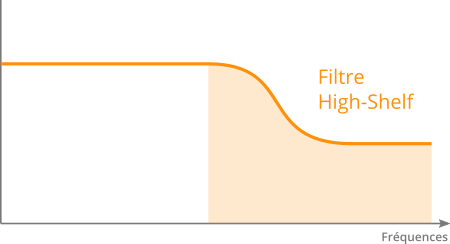
…Nevertheless, low-pass filters are often a bit too extreme.
So what to do?
The solution is simple: use shelf filters, also known as high-shelf filters.
Indeed, these will allow you to sculpt the frequencies of your mix at will but in a much more subtle way and above all much more musically. The original sound will be respected and you will gain in realism.
IN CONCLUSION
You will have understood, in general, it is better to avoid using low-pass filters as much as possible at the risk of losing power and clarity.
Except in very specific cases such as equalizing guitar amps, where these filters excel.
That said, this article should not prevent you from experimenting: mixing also depends on the raw recordings. If they contain too much high frequency, then an LPF may be in order…
And you, in what situation(s) do you use low-pass filters? Leave a comment below 🙂