
Should you record your music in 16 bits? In 24 bits?
The debate may seem endless.
A number of inaccuracies and shortcuts are sometimes taken. For example, it is often said that recording in 24 bits allows for better quality. Or conversely, that recording at more than 16 bits is unnecessary.
In fact, the subject is more complex than it seems, and especially quite abstract.
Ultimately, however, for you who want to record your guitar or your voice in your home studio, you need to make a decision: is it better to record in 16 bits or in 24 bits?
Without going into mathematical calculations, I will explain as clearly as possible what the difference is, so you can make your choice…
And if you still have questions afterwards, feel free to ask them in a comment at the bottom of the article – I will respond as soon as possible 🙂
Analog-to-Digital Conversion
When you record your guitar on your PC via your interface, the analog signal from the guitar is converted into a digital signal so that it can be stored on your computer.
Since the analog signal can take an infinite number of values while computers have a limited capacity, it is sampled according to two parameters:
- Sampling frequency — this is the number of times per second that a measurement of the analog signal is taken (often, it is at 44100 Hz, or 44100 times per second)
- Resolution — this defines the number of possible values that the measured value can take, and is measured in bits.
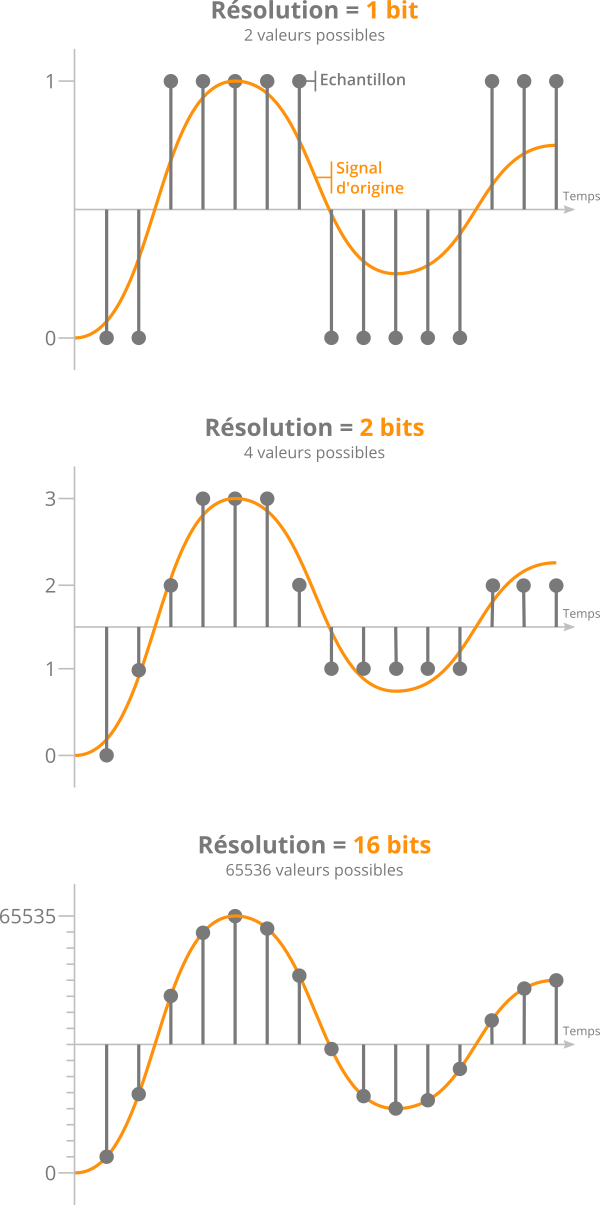
If your resolution is 1 bit, only two values are possible: 0 and 1.
With each bit of resolution added, the number of possible values is multiplied by two:
- 2 bits = 4 values
- 3 bits = 8 values
- 16 bits = 65,536 values
- 24 bits = 16,777,216 values!
When recording, we will measure the incoming signal many times per second and round this measurement based on the number of possible values.
Hypothetical example: our resolution means we can only record values equal to 0 or 1. If the incoming analog signal is measured at 0.8, it will be rounded to 1. If it is measured at 0.2, then it will be rounded to 0.
Pretty simple, right?
As a result, the higher the resolution, the closer the recorded signal will seem to the original signal. This is what you see in the following image:
Also, one might think that recording in 24 bits provides better quality than in 16 bits. Indeed, the resolution seems more precise and the final signal more realistic.
However, that’s not really how it should be viewed…
A Matter of Noise
Earlier, we saw that the values measured from the original signal were rounded during the Analog-to-Digital conversion.
If we reconstruct the signal to listen to it again once the values are rounded, we will realize that it is slightly different from the initial signal.
Here is an example in image:
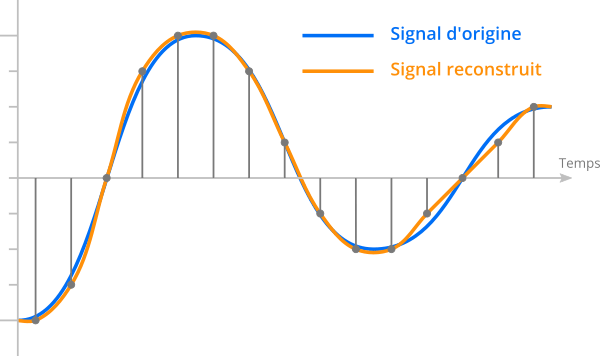
This phenomenon is called quantization error and is inevitable.
If we isolate this error, we realize that it is actually noise, which adds to the signal. A bit like this:
If you increase the resolution (bit depth in English) by adding bits of precision, the error will be smaller and the noise will therefore be less strong.
More specifically, for each bit added, the noise floor is lowered by about -6 decibels (noise floor = noise level).
In other words, for each 1 bit of resolution added, the dynamic range over which you can properly record a signal increases by 6 dB.
We can thus deduce the following figures:
- 16 bits = 16 x 6 = 96 dB dynamic range
- 24 bits = 24 x 6 = 144 dB dynamic range
Ultimately, the only difference between 16 and 24 bits lies in the level of noise. And thus in the dynamic range available for recording, “above” the noise floor.
The Advantage of 24 Bits
The dynamic range of 96 dB corresponding to a 16-bit resolution may seem sufficient for recording most of your instruments. Indeed, even symphonic orchestras have a lower dynamic range (around 50-60 dB)!
That said, to ensure that your recordings are entirely above the noise floor, you will undoubtedly need to push your preamps a bit — otherwise, the weakest parts of your signal will be lost in the quantization error noise.
In 24 bits, however, the problem disappears. Indeed, the noise floor is so low that you can record at a very low level without losing information! All this is because you have a greater dynamic range available. 🙂
And this observation can be extended to mixing with plugins. In 24 bits, your mixing will be free from the noise floor and your audio processing (compression, eq, etc…) will be cleaner.
In summary
You will have understood: recording in 24 bits simply allows you to take fewer risks.
Of course, when your mix is transferred to CD, it will be converted to 16 bits. However, you will have been able to fully enjoy the advantages of 24 bits during recording, and that is the whole point of the technique.
Certainly, it is quite possible to work correctly in 16 bits — but it will only bring you disadvantages, even if you do not notice it immediately.
So, did you understand everything 🙂 ? Feel free to ask your questions below…